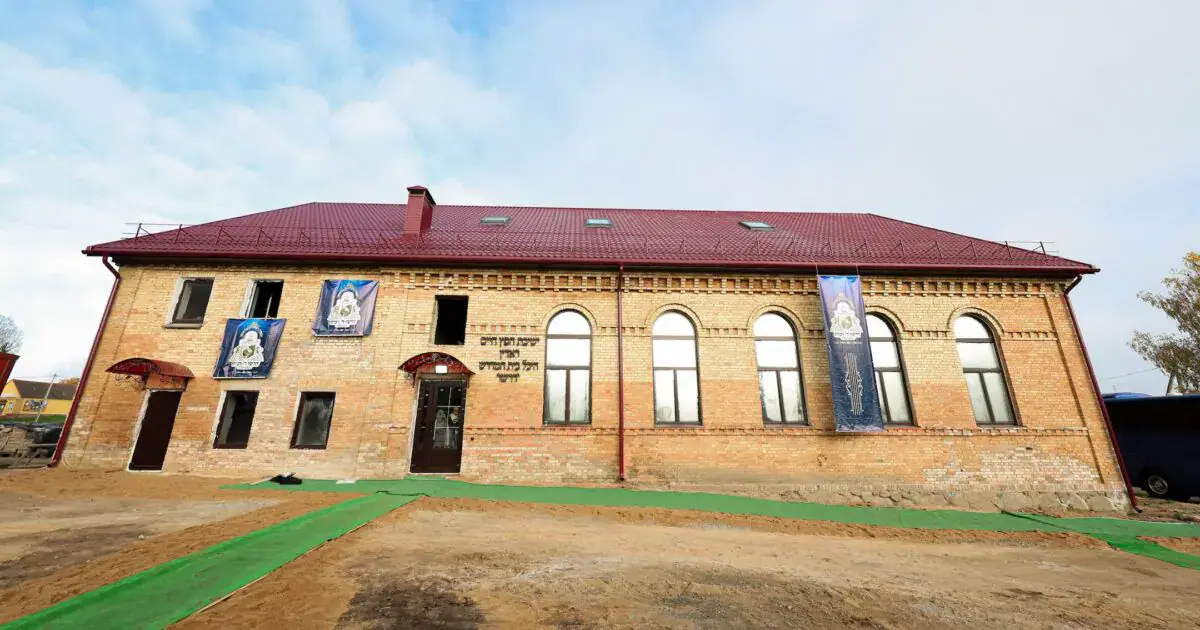
The Radin Yeshiva, located in the small town of Radun in western Belarus, has reopened its doors to students for the first time since World War II. The yeshiva was founded in 1869 by the renowned Lithuanian rabbi Israel Meir Kagan, also known as the Chofetz Chaim. Before the war, the school housed 300 students but was converted into a theatre after the Soviet Union occupied the region.
Rabbi Dovid Hofstedter, a Canadian rabbi and founder of the Torah study organisation Dirshu, played a crucial role in the yeshiva's restoration. Hofstedter discovered the historic Jewish school had turned into a theatre during a visit to Belarus five years ago. He joined a group of rabbis from around the world at the Radin Yeshiva, where he delivered a lecture that filled the building with locals who were unaware of its history as a yeshiva.
The restoration of the Radin Yeshiva was a collaborative effort between Yad Yisroel, a nonprofit dedicated to strengthening Jewish life in Belarus, and international leaders. The project, headed by Hofstedter and Moshe Fhima, involved replacing the building's roof and windows, installing a new Torah ark, and recreating wooden lecterns and chairs. A library of books is being transported from Israel to stock the school's shelves.
The Radin Yeshiva closed after the outbreak of World War II, when the Soviet Union occupied the region and Nazi Germany captured Radun in 1941. Many students escaped to Japan, where they received aid from the American Jewish Joint Distribution Committee. Rabbi Mendel Zaks, the yeshiva's leader and the Chofetz Chaim's son-in-law, fled to the United States and reestablished the yeshiva in New York City.
Hofstedter believes that the Radin Yeshiva will attract interest from Jewish communities across Belarus, despite the country's 30,000 to 50,000 Jews being largely secular. A subset of the community has shown interest in reconnecting with their Jewish identity, and the yeshiva can serve as a focal point for this rediscovery. Many students will also come from abroad, as Orthodox Jews make pilgrimages to study the Chofetz Chaim's teachings and visit his gravesite.
The Chofetz Chaim, who lived from 1838 to 1933, was a leading Jewish scholar of his generation, and his establishment of the Radin Yeshiva brought the town fame in the Jewish world of Eastern Europe. He remains influential among Orthodox Jews globally for his works codifying Jewish law and ethics. There are recent signs of renewed attention to Belarusian and Lithuanian sites of Jewish heritage, including the reopening of the Volozhin Yeshiva as a museum in 2024.
The rededication ceremony of the Radin Yeshiva was an emotional event, with rabbis from the United States, Israel, Britain, France, and elsewhere joining to celebrate the Chofetz Chaim. Hofstedter was moved to see rabbis with a range of backgrounds and beliefs come together with a feeling of solidarity. The yeshiva's reopening is seen as a continuation of the Chofetz Chaim's teachings for future generations.
Key points
- The Radin Yeshiva has been restored and reopened as a school for Torah students after being converted into a theatre following World War II.
- The yeshiva's restoration was a collaborative effort between Yad Yisroel and international leaders, including Rabbi Dovid Hofstedter.
- The Radin Yeshiva is expected to attract interest from Jewish communities across Belarus and abroad, serving as a focal point for reconnecting with Jewish identity and heritage.