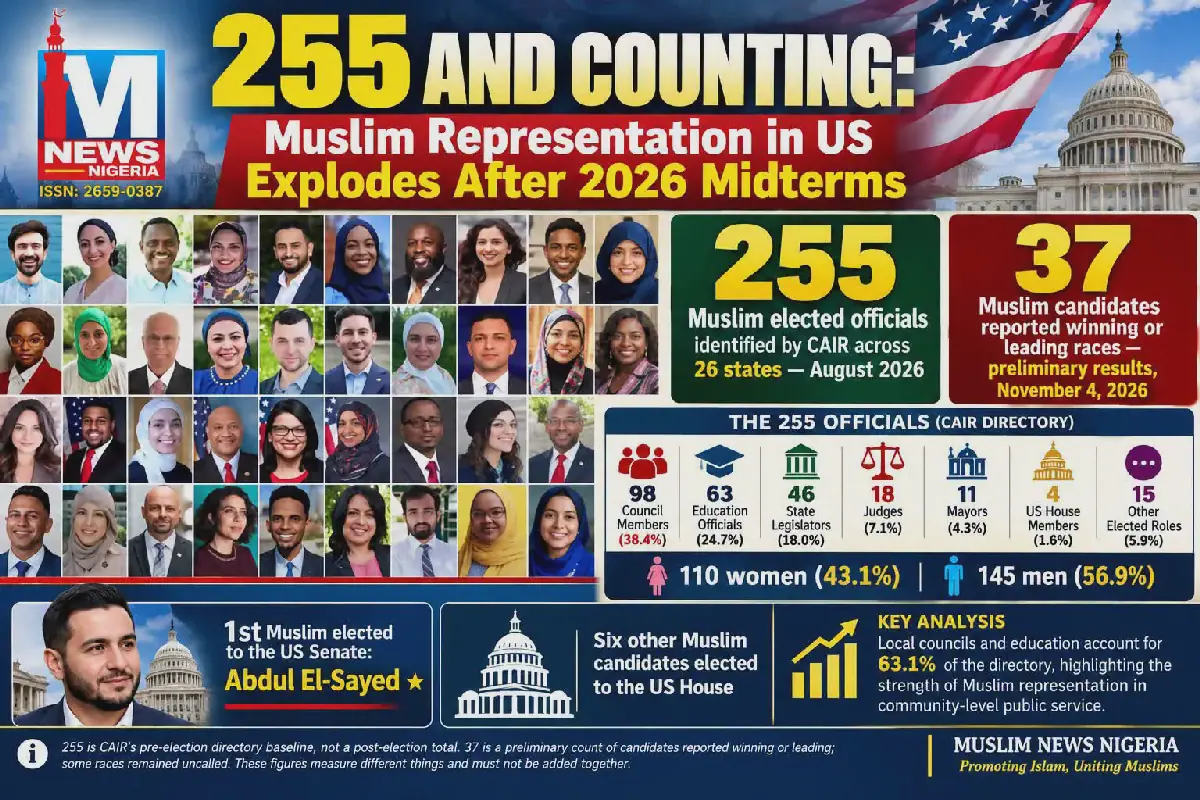
In a historic midterm election result, Abdul Rahman Mohamed El-Sayed, a Democrat from Michigan, has become the first Muslim elected to the United States Senate. El-Sayed, a 42-year-old former public health official, defeated Republican candidate Mike Rogers in Michigan's Senate race. His victory marks a significant milestone in American political representation, with a Muslim among the 100 members of the US Senate for the first time. El-Sayed will assume office when the 120th US Congress begins in January 2027.
El-Sayed's campaign attracted national attention, particularly over his Muslim identity, progressive political positions, and criticism of US support for Israel. During the campaign, President Donald Trump questioned El-Sayed's security, suggesting he should undergo a metal detector screening. El-Sayed responded by challenging Trump to take a lie detector test. El-Sayed also questioned Trump over convicted sex offender Jeffrey Epstein and his repeated claims about the outcome of the 2020 presidential election.
El-Sayed's Republican opponent sought to portray him as sympathetic to Islamic extremism, citing alleged links to the Muslim Brotherhood. However, El-Sayed denied these allegations, which were unsupported by evidence. His criticism of Israeli military operations in Gaza, which he described as genocide, and opposition to US military assistance to Israel, were also prominent in the campaign.
El-Sayed's historic Senate victory was accompanied by significant gains for Muslim candidates seeking seats in the House of Representatives. Six Muslim Americans secured congressional seats, bringing the number of Muslim winners in the federal legislature to at least seven. Incumbent lawmakers Congresswoman Ilhan Omar of Minnesota, Congresswoman Rashida Tlaib of Michigan, Congressman André Carson of Indiana, and Congresswoman Lateefah Simon of California retained their seats.
Two newcomers, Adam Hamawy of New Jersey and Darializa Avila Chevalier of New York, also won congressional seats. Hamawy, a former US Army surgeon who served in Gaza, becomes the first Muslim elected to Congress from New Jersey. Chevalier, a Democrat and convert to Islam, won New York's 13th Congressional District after defeating longtime incumbent Adriano Espaillat in the Democratic primary.
Beyond Congress, Muslim political representation in the United States has continued to expand. The Council on American-Islamic Relations (CAIR) and CAIR Action published their 2026 Directory of Elected Muslim Officials, identifying 255 Muslim elected officials across 26 states. The directory recorded 110 Muslim women, representing 43.1 per cent of the total. New Jersey had the highest number of Muslim elected officials, with 46, followed by Michigan with 40.
Several other Muslim candidates also recorded important victories in state legislative and local elections. In New York, Palestinian-American organiser Aber Kawas won the 12th State Senate District in Queens, becoming the first Palestinian-American and Muslim woman elected to the New York State Legislature. In Minneapolis, Minnesota, the city became the first major US city to allow mosques to publicly broadcast the Islamic call to prayer, or adhan, for all five daily prayers.
Key points
- Abdul Rahman Mohamed El-Sayed becomes the first Muslim elected to the US Senate.
- Six Muslim Americans secure congressional seats in the House of Representatives.
- Muslim political representation in the US expands, with 255 Muslim elected officials across 26 states.