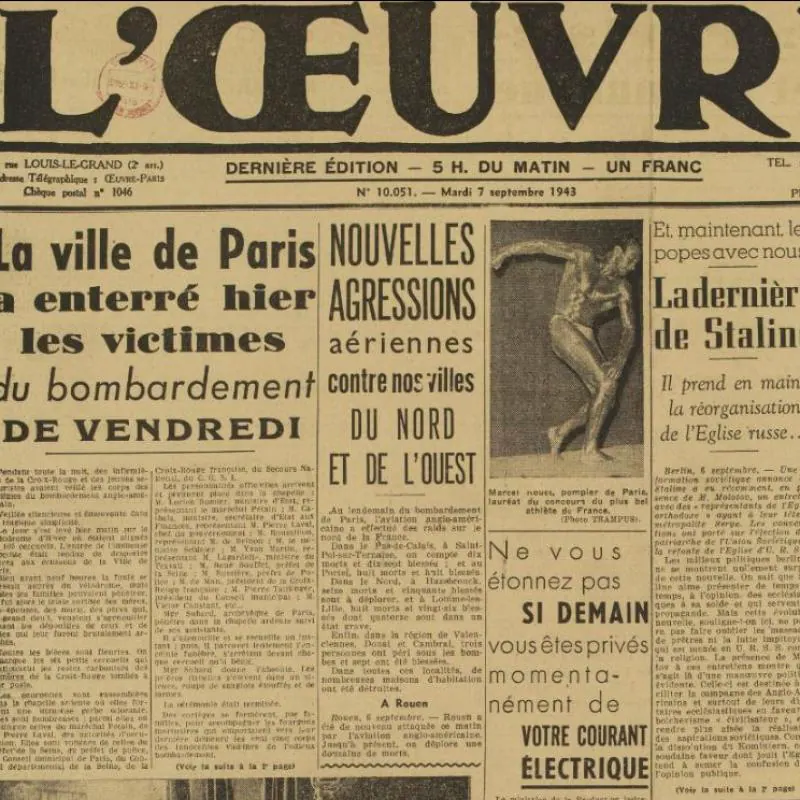
French historian Pierre-Marie Dioudonnat has published a new book, "La France allemande et ses journaux," which explores the Nazi control of the French press during World War II. This book is a follow-up to his 1981 publication, "L'argent nazi à la conquête de la presse française." Dioudonnat's latest work delves into the role of key figures such as Pierre Laval and Jean Luchaire in facilitating Nazi control of the French press. The book is based on extensive research, including newly discovered archives.
Dioudonnat's decision to publish a new book 45 years after his first was sparked by the discovery of new information. In 2009, he stumbled upon an important document in the archives of Charles Dubost, a magistrate who had investigated Albert Lejeune, a press mogul implicated in collaboration with the Nazis. Lejeune's testimony, given on the eve of his execution in January 1945, provided crucial insights that led Dioudonnat to re-examine the period. This new research has enabled him to shed more light on the complex relationships between the Nazi occupiers, the French government, and the press.
The title of Dioudonnat's book, "La France allemande et ses journaux," reflects the reality of the situation in France during the Nazi occupation. The armistice of June 22, 1940, significantly reduced French sovereignty, and the government of Marshal Philippe Pétain collaborated closely with the Nazi authorities. The press, which had previously been a diverse and thriving sector, was severely impacted by the occupation. Many newspapers were forced to cease publication or adapt to the new circumstances, while others actively collaborated with the Nazi authorities.
In the aftermath of the French defeat, the press landscape was drastically altered. The large Parisian newspapers evacuated the capital, while provincial newspapers struggled to continue publication. In the occupied zone, the Nazi authorities did not have a clear strategy for controlling the press, but they quickly established a system of censorship and propaganda. The German military authorities set up a section of propaganda to oversee the press, with the goal of promoting calm and stability.
One of the key figures in the Nazi control of the French press was Gérard Hibbelen, a relatively unknown but influential individual. Hibbelen, who was German but fluent in French and familiar with Parisian slang, played a significant role in the occupied capital from the spring of 1941. He was a close supporter of the Nazi regime and worked to promote its ideology through the press. Dioudonnat's book sheds new light on Hibbelen's activities and the broader context of Nazi control of the French press.
The Nazi occupation of France had a profound impact on the country's press and media landscape. Many newspapers and journalists were forced to adapt to the new circumstances, while others actively collaborated with the Nazi authorities. Dioudonnat's book provides a detailed examination of this complex period, highlighting the ways in which the Nazi regime sought to control and manipulate the press for its own purposes. The book is based on extensive research and draws on a range of archival sources.
Dioudonnat's work offers a nuanced understanding of the complex relationships between the Nazi occupiers, the French government, and the press during World War II. His book provides a valuable contribution to the historiography of the period, shedding new light on the ways in which the Nazi regime sought to control and manipulate the press. By examining the role of key figures such as Pierre Laval, Jean Luchaire, and Gérard Hibbelen, Dioudonnat's book offers a rich and detailed exploration of this important topic.
Key points
- Historian Pierre-Marie Dioudonnat has published a new book examining Nazi control of the French press during WWII.
- The book, "La France allemande et ses journaux," is a follow-up to Dioudonnat's 1981 publication, "L'argent nazi à la conquête de la presse française."
- Dioudonnat's research sheds new light on the complex relationships between the Nazi occupiers, the French government, and the press during World War II.