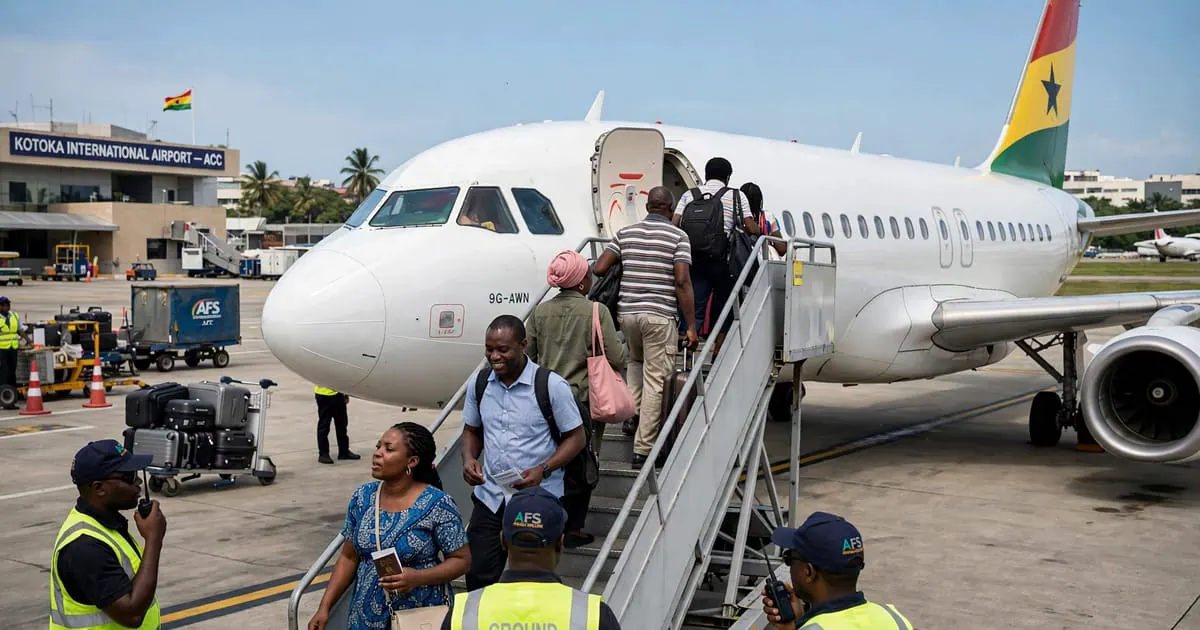
A recent social media post highlighting the high cost of domestic air travel in Ghana has sparked a national conversation about the affordability of flying within the country. Many Ghanaians feel that domestic airfares are out of reach for ordinary workers and families. The issue has been attributed to various factors, including the cost of doing business in Ghana and the structure of the aviation industry.
The cost of domestic air travel in Ghana is part of a broader issue known as the "Ghanaian pricing culture," where everyday business inputs, hotel rooms, residential accommodation, office rent, and car rentals are often expensive relative to income levels. Airlines, which buy many of these inputs, also face aviation-specific costs, many of which are priced in dollars. This has resulted in high ticket prices for domestic flights.
The structure of the market has also contributed to the high cost of domestic airfares. In 2012, there were four players in the market, including Starbow, AWA, Citylink, and Fly540, which helped keep prices low. However, when the market dwindled to one player in 2017, prices began to increase. Today, Africa World Airlines and PassionAir are the two main scheduled domestic operators, which has limited competition and driven up fares.
A recent fare survey comparing Ghanaian fares with those in other African and Indian markets revealed that Ghana's average lowest return fare was US$313.06, while the average highest was US$450.48. In comparison, the average lowest and highest return fares in Nigeria, South Africa, Kenya, and India were US$181.50 and US$227.00, respectively. The survey suggests that Ghana's domestic airfares are significantly higher than those in other markets.
Several factors contribute to the high domestic fares in Ghana, including the country's limited scale, currency and input-cost pressure, and limited competition. The Ghana Civil Aviation Authority recorded 903,227 domestic passenger movements in 2025, with Kumasi accounting for about 54 percent of movements. Thin routes and uneven demand make frequent service harder to sustain, which can drive up costs.
The government charges, including the Airport Infrastructure Development Charge of GH¢200 for a return trip, also form part of the fare. Additionally, the Russian-Ukraine and Middle East wars have pushed fuel prices up, resulting in higher fuel surcharges for airlines. To address these challenges, the government has been urged to undertake comparative cost studies and consider measures to reduce taxes, charges, and regulatory costs that place Ghanaian airlines at a disadvantage.
The Ministry of Transport, the Ghana Civil Aviation Authority, and Ghana Airports Company Limited are expected to consider measures to address the factors driving up domestic airfares. By reducing operating costs and stimulating passenger demand, the government aims to make Accra an aviation hub for West Africa. Lower airfares could improve aircraft capacity utilization and make air travel more accessible to Ghanaians.
Key points
- The high cost of domestic air travel in Ghana is attributed to various factors, including the country's limited scale, currency and input-cost pressure, and limited competition.
- A recent fare survey revealed that Ghana's domestic airfares are significantly higher than those in other African and Indian markets.
- The government has been urged to undertake comparative cost studies and consider measures to reduce taxes, charges, and regulatory costs that place Ghanaian airlines at a disadvantage.