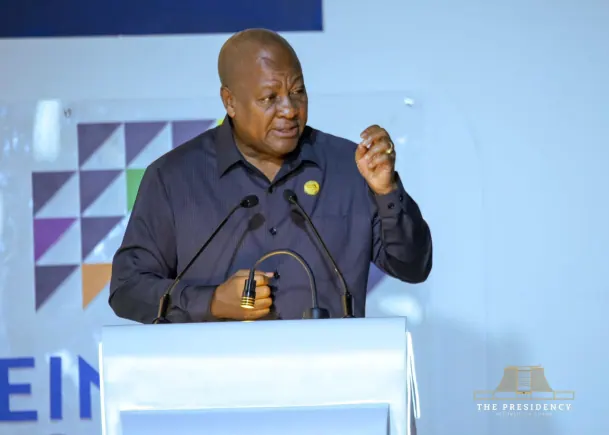
President John Dramani Mahama has called on African leaders to make health sovereignty a priority, emphasizing that it is crucial for the continent's 1.4 billion people to achieve economic and fiscal security. Speaking at the Alamein Africa Forum in Egypt on October 3, 2026, President Mahama stated that Africa must stop treating health as a charitable cost and instead position it as a high-growth economic sector. He argued that this shift in perspective is essential for the continent's development.
President Mahama highlighted the need for investment in health, citing global evidence that it drives human capital, manufacturing, job creation, and macroeconomic stability. He referenced the Copenhagen Consensus, which showed that a targeted package of basic emergency maternal and newborn care can yield $87 in economic and social returns for every dollar invested. Additionally, the Lancet Commission found that falling mortality rates accounted for nearly a quarter of total income growth in developing economies in the early 2000s.
The President pointed out Africa's heavy reliance on imported pharmaceuticals and vaccines, with over 70% of pharmaceuticals and nearly 99% of vaccines being imported. This results in tens of billions of dollars leaving African economies annually to purchase medicines abroad. He also noted that traditional donor assistance is declining, with OECD projections indicating a 29-46% decrease in health aid compared to 2024 levels.
President Mahama emphasized that governments cannot fund the transition to health sovereignty alone and called for private capital, industrial developers, commercial banks, and sovereign funds to participate. He cited initiatives like Business United for Mothers, Babies, and Youth, championed by President Samia Suluhu Hassan of Tanzania, as examples of partnerships that can drive progress. He urged African leaders to stop treating health as an expense item in their budgets and instead build factories, integrate supply chains, fund innovators, and secure the future of their citizens.
The President highlighted the potential of the African Continental Free Trade Area (AfCFTA) in driving the development of a vibrant local pharmaceutical manufacturing sector. He argued that the AfCFTA provides a single continental market of 1.4 billion consumers, which can serve as a captive market for African manufacturers. President Mahama also cited the Africa CDC's first pooled tender for maternal and child health products, which achieved price reductions of over 30% and ensured African manufacturers won 50% of product lines.
President Mahama pointed to successful continental initiatives, such as Egypt's elimination of hepatitis C, which reduced prevalence from 10% to under 0.5% through technology transfer and domestic production. He also cited Nigeria's African Medical Centre of Excellence in Abuja, which aims to tackle the $6 billion annual loss to outbound medical tourism. In Ghana, the government is implementing the Accra Reset, which includes expanding the National Health Insurance Scheme and introducing a free primary health care program.
To scale up such successes, President Mahama announced the launch of the Health Investment and National Gateway, or HINGE, Enabler. Developed with the African Medicines Agency, Institute Pasteur, and Afrochampions, HINGE will become a digital platform that streamlines regulations, clinical validation, and commercialization into a unified process for innovators and investors. The President also announced that dedicated task forces and reformed inter-ministerial observatories will track capital flows, enforce policy commitments, and dismantle non-tariff barriers across regional value chains.
Key points
- President Mahama urges African leaders to prioritize health sovereignty as a high-growth economic sector.
- Africa imports over 70% of its pharmaceuticals and nearly 99% of its vaccines, resulting in significant capital outflows.
- The President launches the HINGE Enabler to streamline regulations and commercialization for health innovators and investors.