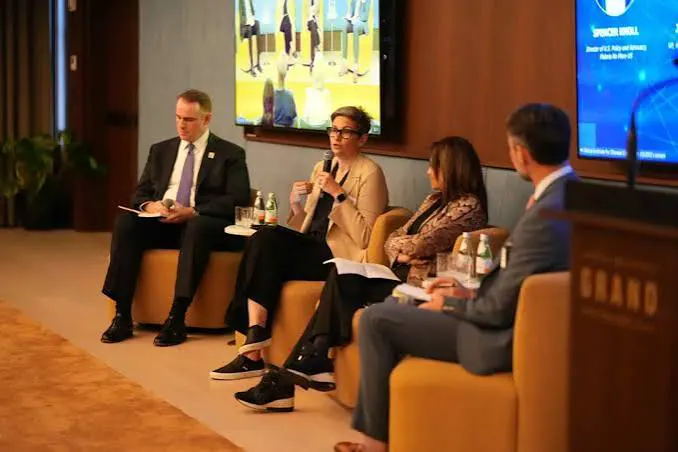
Health leaders, development partners, and diagnostics experts gathered at a high-level event on the sidelines of the 81st session of the United Nations General Assembly in New York to discuss the role of artificial intelligence (AI) in accelerating malaria elimination. The event, co-hosted by the Global Institute for Disease Elimination (GLIDE), the RBM Partnership to End Malaria, and Nigeria, aimed to explore how AI can support more efficient health investments and strengthen disease surveillance. With declining donor funding and growing pressure on development and humanitarian financing, participants emphasized the need for innovative solutions to combat preventable diseases.
The keynote address was delivered by Prof. Muhammad Ali Pate, Coordinating Minister of Health and Social Welfare, who emphasized the importance of country-led adoption of emerging technologies. Represented by Dr. Michael Adekunle Charles, CEO of the RBM Partnership to End Malaria, Pate stressed that malaria-endemic countries should be central to decisions on technology adoption. He highlighted the RBM Partnership's "Big Push against Malaria" initiative, which brings partners together around country priorities and connects countries with expertise, data, resources, and technical support.
Nigeria accounts for the largest share of the global malaria burden and is implementing the Health Sector Renewal Investment Initiative to strengthen primary healthcare and domestic health financing. Pate noted that collaboration between RBM and GLIDE would help translate global knowledge and innovation into practical, country-led action. GLIDE CEO Dr. Farida Hosani echoed this sentiment, emphasizing that progress towards malaria elimination depends on converting global knowledge and innovation into practical capabilities at the country level.
The partnership between GLIDE and RBM aims to equip national programs and public health leaders with the tools, knowledge, and partnerships needed to advance disease elimination in ways that reflect their priorities and local realities. GLIDE announced new AI training programs for national program managers and public health leaders, including the GLIDE Leadership Excellence in AI for Health (GLIDE_LEAH) and AI for All. These programs aim to equip health leaders with the knowledge, confidence, and safeguards needed to apply AI to strengthen health systems and accelerate disease elimination.
A panel discussion chaired by Metli Co-Founder Sam Macintosh focused on the investment and implementation conditions required to scale AI-enabled health programs. Panelists stressed the need to connect funding with viable opportunities while ensuring that data infrastructure, workforce capacity, and health-system integration are in place to support sustainable progress. The panel included experts from the Pandemic Fund, Roche Diagnostics, and Malaria No More US.
The event concluded with the signing of a Letter of Mutual Understanding between GLIDE and the RBM Partnership to End Malaria. The agreement formalizes collaboration between the two organizations to place countries most affected by malaria at the center of malaria control and elimination efforts. It provides a framework for linking global expertise, AI, and technical innovation with the priorities of national malaria control programs and affected communities.
The partnership aligns with the World Health Organisation's Global Technical Strategy for Malaria and supports efforts to provide countries with the expertise, learning, and practical resources needed to control and eliminate the disease. By leveraging AI and other technologies, health leaders aim to accelerate malaria elimination and make better use of limited health resources. The initiative is expected to have a significant impact on malaria-endemic countries, including Nigeria, which bears the largest share of the global malaria burden.
Key points
- Health leaders call for country-led adoption of AI to accelerate malaria elimination
- GLIDE and RBM Partnership to collaborate on AI training programs for national program managers and public health leaders
- Partnership aims to equip countries with expertise, learning, and practical resources needed to control and eliminate malaria