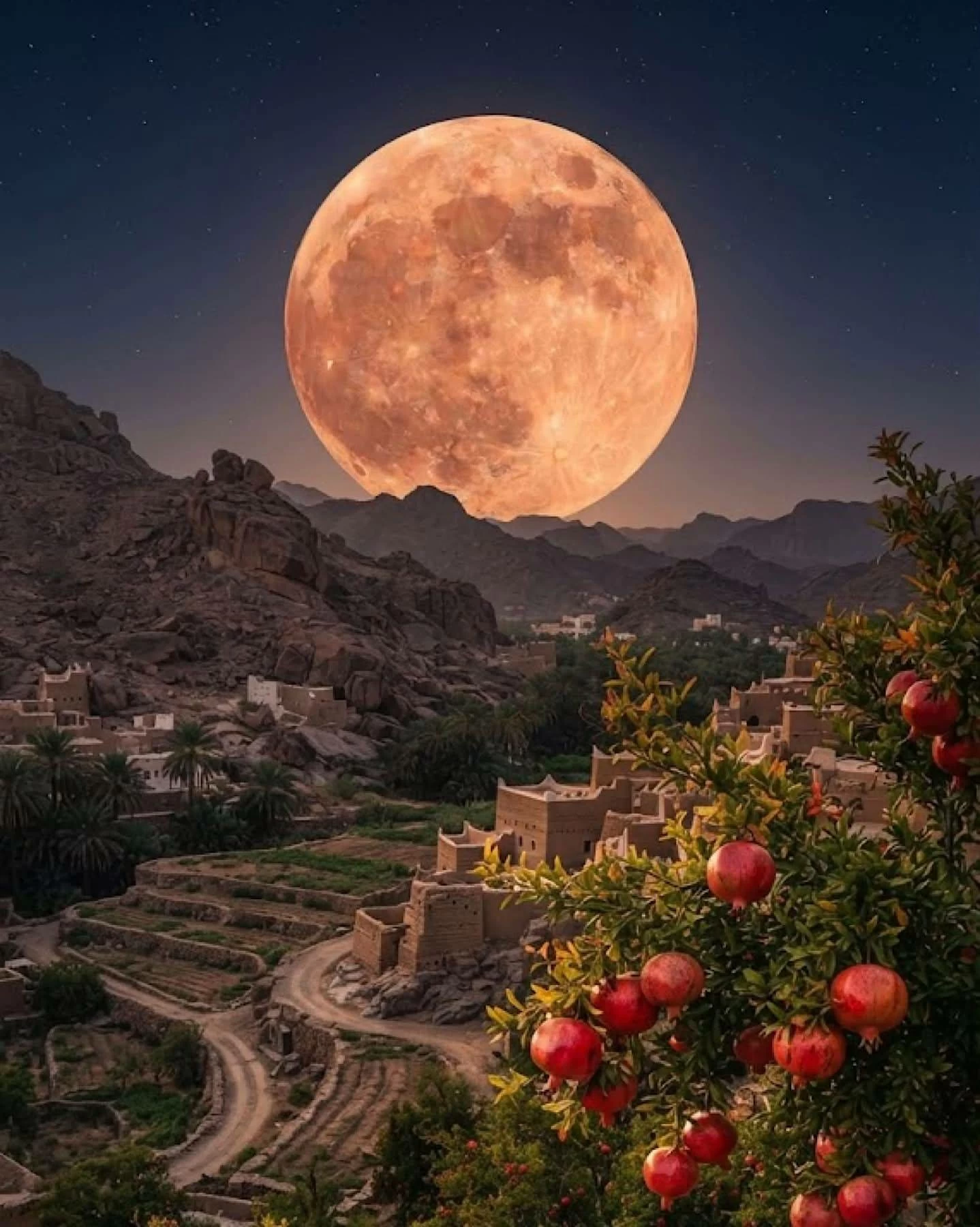
On September 26, 2026, the Arab world's skies were treated to a stunning spectacle as the September full moon, commonly referred to as the Harvest Moon, reached completion. This phenomenon occurred just days before the autumnal equinox, providing a unique opportunity for stargazers and photography enthusiasts to capture the moon's beauty in the evening sky. According to the Jeddah Astronomical Society, the moon was fully illuminated and visible to the naked eye, with binoculars and small telescopes offering a closer look at its surface features.
The Harvest Moon is a traditional name for the full moon that occurs closest to the autumnal equinox in the Northern Hemisphere. This particular moon is also sometimes referred to as the "Fruit Moon" or "Barley Moon" in various cultures. In Saudi Arabia, locals have proposed the name "Pomegranate Moon" for this full moon, inspired by the country's pomegranate harvest season. This name is a nod to the region's agricultural heritage and the vibrant colors of the pomegranate fruit.
The September full moon appeared larger when near the horizon due to an optical illusion known as the "moon illusion." This phenomenon occurs when the brain perceives the moon as larger when it is near objects on the horizon, such as buildings or trees. However, the moon's size remains the same, and this effect is merely a trick of the mind. The moon's color can also take on a reddish hue when it is near the horizon, due to the scattering of shorter wavelengths of light in the Earth's atmosphere.
On the evening of September 26, the full moon appeared close to the planet Saturn in the sky, creating a visually striking scene. While the two celestial bodies were not actually close in space, they appeared to be in close proximity to each other from the vantage point of Earth. This alignment provided a unique opportunity for astronomers and photographers to capture the beauty of the moon and Saturn together in the same frame.
The Harvest Moon has historically been significant for farmers, as it provided additional light during the evening hours, allowing them to work longer into the night during the harvest season. This full moon occurred during a period of changing seasons, when the Earth's axis is tilted neither towards nor away from the sun. As a result, the moon's apparent motion in the sky changes, making it appear to rise and set at different times each night.
The Jeddah Astronomical Society noted that the September full moon was a special event, combining the beauty of the night sky with the spirit of the harvest season. The society encouraged people to take a moment to appreciate the beauty of the universe and the connection between celestial events and the changing seasons on Earth. This full moon was a reminder of the intricate relationships between the Earth, sun, and moon.
The Harvest Moon will continue to be visible in the Arab world's skies for several nights, offering a chance for people to observe and appreciate its beauty. As the seasons change and the nights grow cooler, the full moon will remain a constant presence in the night sky, a reminder of the beauty and wonder of the universe. The Pomegranate Moon, as it has been dubbed in Saudi Arabia, will be a memorable sight for those who witnessed it on September 26.
Key points
- The September full moon, also known as the Harvest Moon, was visible in the Arab world's skies on September 26, 2026.
- The full moon appeared close to the planet Saturn in the sky, creating a visually striking scene.
- The Harvest Moon has historically been significant for farmers, providing additional light during the evening hours during the harvest season.