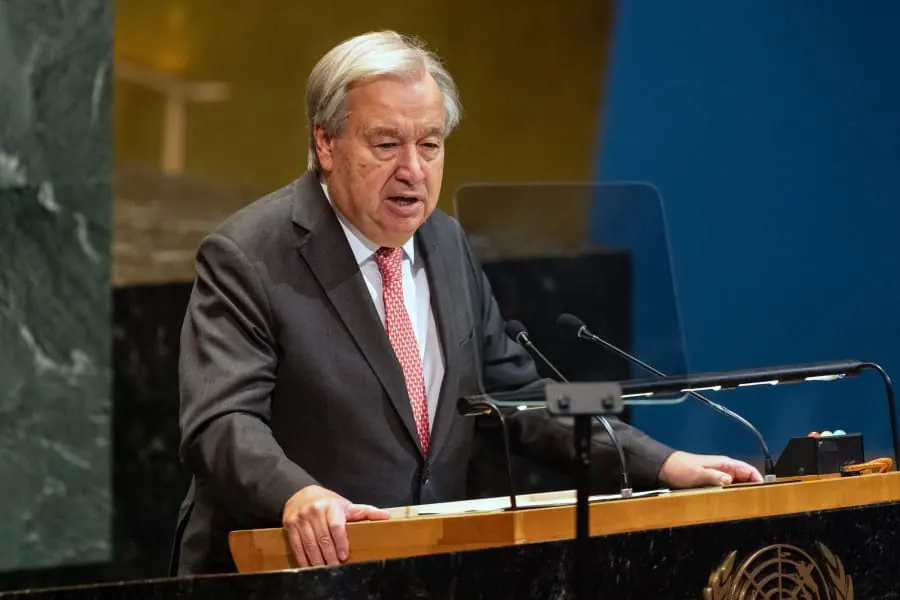
United Nations Secretary-General António Guterres delivered a stern warning at the 2026 UN General Assembly, highlighting a "convergence of unprecedented threats" and growing pressure on international cooperation mechanisms. Speaking at the onset of his final UNGA debate as Secretary-General, Guterres emphasized that the world's fractures are widening, and "fissures have turned into abysses." He pointed to the devastating consequences of wars that have erupted over the past decade, resulting in civilian casualties, human rights abuses, and humanitarian workers being killed.
Guterres noted that the international community has witnessed a decline in respect for human rights, with the use of famine as a weapon and the targeting of civilians. He also highlighted the crisis of climate change, which has transitioned from a distant warning to a daily reality. Furthermore, the rapid advancement of artificial intelligence has caught even its creators off guard. The Secretary-General emphasized that these crises are not isolated but rather interconnected chapters in the story of power and its distribution.
The Secretary-General criticized the current global power dynamics, where new centers of economic, political, and technological influence have emerged among states. However, he also noted an extraordinary transfer of power from governments to a small group of private companies and individuals. This shift has significant implications for politics, economies, information flows, technological development, and civic spaces that societies depend on.
Guterres expressed concern about the increasing reliance on machines, citing the risks associated with uncontrolled artificial intelligence agents and lethal autonomous weapons. Despite these drastic changes, he argued that global governance institutions and systems still reflect the power realities and interests of a largely bygone era. The Secretary-General emphasized that this is the critical challenge facing humanity, as the mechanisms for collective action are under growing pressure.
With about three months left in his tenure, Guterres envisioned a multipolar world, where power is distributed among various actors. However, he advocated for a networked multipolarity, built on interdependence and sustained by a dense web of economic, political, social, and technological connections. This approach, he believed, could help mitigate hegemonic tendencies and the division of the world into rival blocs with separate economic, technological, and security systems.
Guterres emphasized that building this future begins with the recognition, especially by superpowers, that their power has limits. He stressed that countries do not need to start from scratch, as the UN Charter provides a solid foundation. The Secretary-General's comments were broadcast on RecordTV Cabo Verde, a prominent news outlet in Cabo Verde.
As Guterres prepares to leave his position, his remarks underscore the need for urgent attention to the converging threats facing the world. The UNGA debate serves as a critical platform for world leaders to address these challenges and work towards a more cooperative and equitable global order. The outcome of this debate and the actions that follow will be crucial in shaping the future of international relations and global governance.
Key points
- Guterres warns of converging threats and growing pressure on international cooperation at the UNGA.
- The Secretary-General advocates for a networked multipolarity, built on interdependence and sustained by a dense web of connections.
- Guterres emphasizes the need for recognition of the limits of power, especially by superpowers, to build a more equitable global order.