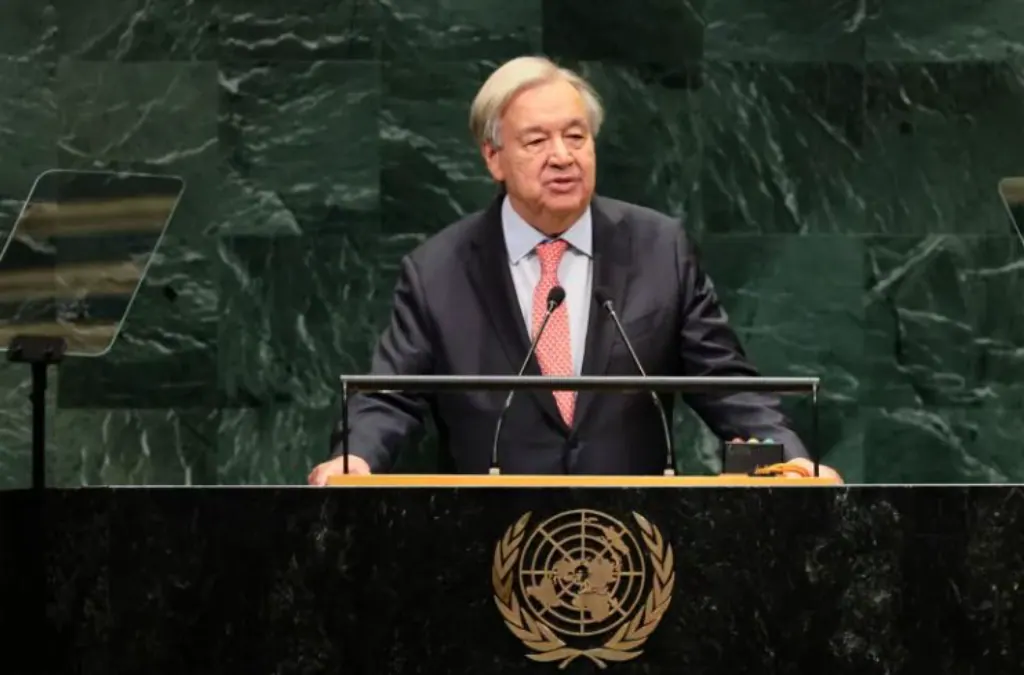
UN Secretary-General António Guterres addressed the UN General Assembly, his last as secretary-general, warning of a "convergence of threats without precedent" in the world. He stated that collective mechanisms are under growing pressure, new centers of influence have emerged, and there is a growing transfer of power to companies and individuals. Guterres expressed concern about the increasing divisions, inequalities, and erosion of trust in the world.
Guterres reviewed the past decade, highlighting devastating wars, human rights abuses, and the use of famine as a weapon. He noted that international law has been disregarded, geopolitical divisions have deepened, and inequalities have intensified. The secretary-general also pointed out that the climate crisis has become a daily reality, and artificial intelligence has advanced at an unprecedented pace.
The secretary-general criticized the way power is being reshaped, with new centers of economic, political, and technological influence emerging among states. However, he also noted an extraordinary transfer of power from governments to a small group of private companies and individuals. Guterres expressed concern about the reach of these private entities, which now extends to politics, economy, information flows, technological development, and civic space.
Guterres highlighted the risks associated with the increasing reliance on machines, citing uncontrolled artificial intelligence agents and lethal autonomous weapons. Despite these drastic changes, he noted that global governance institutions and systems still reflect the power realities and interests of a largely past era. The secretary-general emphasized the need for a new approach to address these challenges.
Guterres acknowledged that the world is moving towards a multipolar order, but urged that it should be a networked multipolarity, built on interdependence and sustained by a dense web of economic, political, social, and technological connections. He argued that this approach can help avoid hegemonic tendencies and the division of the world into rival blocs.
The secretary-general emphasized that building this future requires recognition, especially by superpowers, that their power has limits. He noted that countries do not have to start from scratch, as they have the UN Charter as a solid foundation. Guterres' comments reflect his concerns about the current state of global affairs and his vision for a more cooperative and equitable world.
As Guterres prepares to leave his position as UN secretary-general, his speech highlights the need for urgent action to address the converging threats facing the world. His call for a new approach to global governance and a more equitable distribution of power reflects his commitment to finding solutions to the complex challenges facing humanity.
Key points
- Guterres warns of converging threats without precedent in the world
- The secretary-general criticizes the transfer of power to private companies and individuals
- Guterres advocates for a networked multipolarity built on interdependence