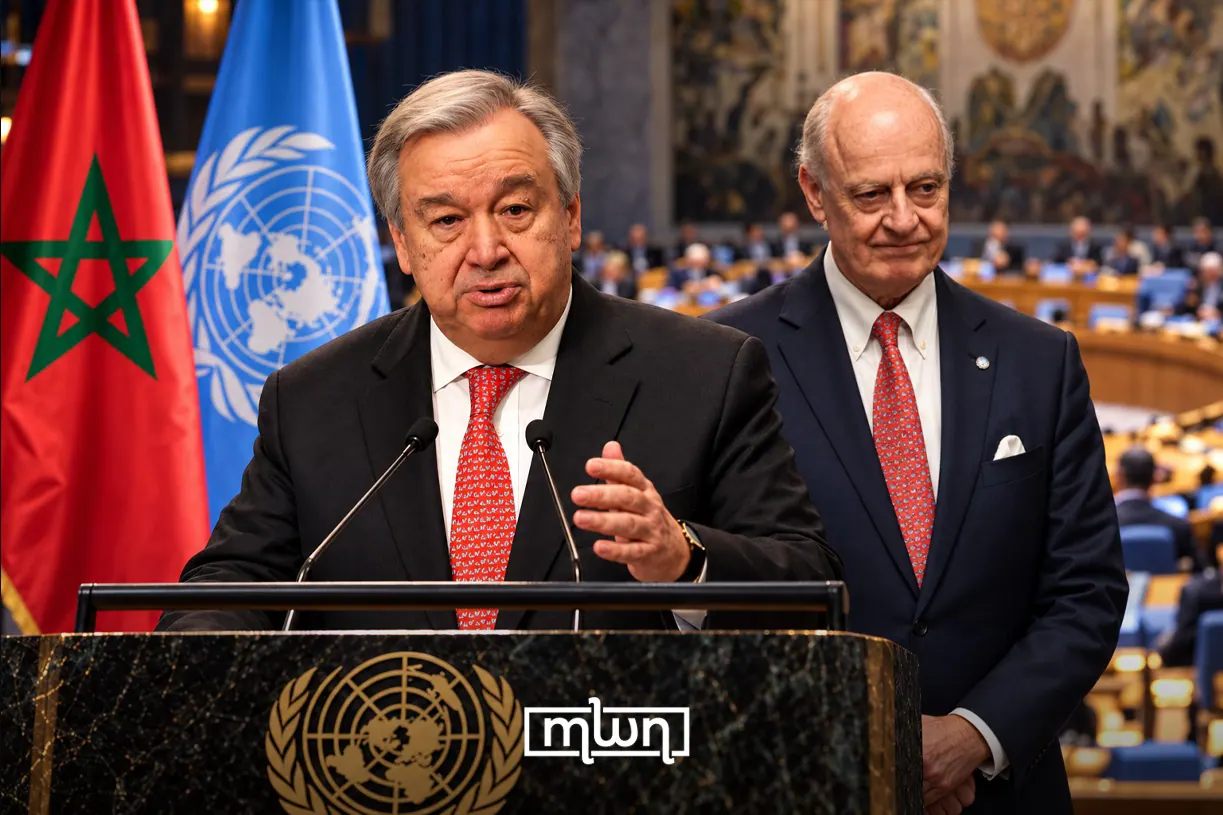
UN Secretary-General Antonio Guterres has reiterated the importance of the Moroccan Autonomy Plan as a basis for negotiations toward a lasting political solution to the Western Sahara dispute. In his annual report, Guterres urged all parties, including Algeria, Polisario, Mauritania, and Morocco, to engage in good-faith negotiations to explore the possibility of achieving genuine autonomy for the people of Western Sahara. This approach is seen as the most feasible outcome, citing UN Security Council Resolution 2797.
The UN Security Council Resolution 2797, adopted in October 2025, recognized the Moroccan Autonomy Plan as a genuine political solution able to end the dispute over Western Sahara. The resolution called on all parties to engage in negotiations, with Morocco's Autonomy Plan serving as the only basis for the talks. Guterres emphasized that any proposal should be subject to a meaningful consultation process with the people of Western Sahara, allowing them to accept or reject it.
Morocco has consistently maintained that "self-determination" does not necessarily mean a referendum, as Algeria and Polisario claim. Moroccan Foreign Affairs Minister Nasser Bourita stated that self-determination can take different forms within the framework of Morocco's Autonomy Plan. This stance is supported by over 130 countries, including the US, which backs the Moroccan Autonomy Plan as the only feasible political solution.
Algeria, however, continues to refuse to shoulder responsibility in the dispute, despite its direct involvement in supporting the separatist group Polisario. Algeria's regime has long used ambiguity to define itself as an observer rather than a main party to the dispute. The UN Security Council Resolution 2797 explicitly called on Algeria to participate in talks as a main party and contribute to finding a mutually acceptable political solution.
Algeria's Foreign Affairs Minister Ahmed Attaf reaffirmed Algiers' support for Polisario's outdated claims, including self-determination, at the UN General Assembly. He claimed that decolonization ends when people are enabled to exercise their rights guaranteed under international law. Guterres' report, however, stressed the importance of Resolution 2797, which has revived negotiations and given renewed momentum to the UN-led political process.
The report also noted the growing number of countries that support the Moroccan Autonomy Plan, including Mali, Honduras, and Bolivia, which have aligned themselves with Morocco's position. Madagascar, Canada, and Japan, as well as the EU, also support Morocco's initiative. Peru, Chile, and Panama have recently joined the growing consensus in support of the Moroccan Autonomy Plan.
Guterres' report also mentioned that Morocco has provided details of its 2007 Autonomy Plan, including a "Draft Statute for Autonomy," which was shared with UN envoy Staffan de Mistura and the US. The UNSG emphasized that a meaningful consultation process with the people of Western Sahara is essential to ensure that they are not further deprived of their inalienable right to self-determination.
Key points
- The UN Secretary-General has called on parties to the Western Sahara dispute to explore the possibility of achieving genuine autonomy for the people of Western Sahara.
- The Moroccan Autonomy Plan is seen as the most feasible solution, backed by over 130 countries, including the US.
- Algeria continues to support Polisario's outdated claims, despite the UN Security Council Resolution 2797 calling for Algeria to participate in talks as a main party.