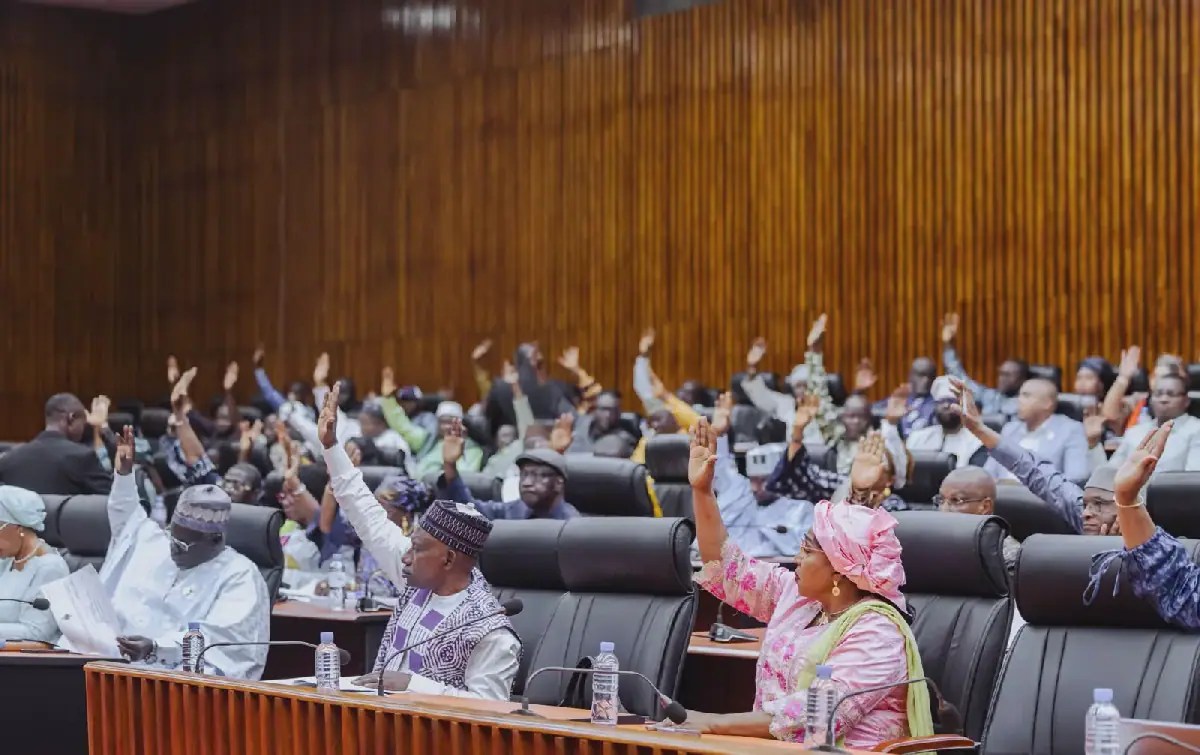
On November 1, 2026, the Guinean parliament convened to examine and adopt the revenue portion of the 2026 Revised Finance Law (PLFR). The law, presented by N'Gouamou Fabara KONE, Rapporteur General of the Economic and Financial Affairs Commission, aims to adjust the budget in response to national and international economic changes. The revisions align with the priorities of the Simandou 2040 program, initiated by President Mamadi DOUMBOUYA.
The revised law accounts for new government priorities and global economic fluctuations. The projected budget revenues have increased to 60,064.47 billion GNF, up from 55,858.10 billion GNF in the initial 2026 finance law, representing a 7.53% growth. The law also revises the inflation rate to 5.2%, up from 3.5%, and sets the exchange rate at 8,710 GNF per US dollar, compared to the initial 8,838 GNF.
The parliamentary process involved intense work in commissions and inter-commissions. The National Assembly acknowledged the performance of financial regies while issuing recommendations to optimize domestic revenue mobilization. Deputies emphasized the need to combat losses due to excessive fiscal exemptions, particularly in the mining sector, which significantly impact state revenue.
The parliament also drew attention to the management of public participations and undivided dividends from strategic enterprises. They called for restructuring the Electricity Distribution Company (EDG) by improving invoice collection, revising the management and governance model, and enhancing financial discipline in relations with hydroelectric dam management companies.
The adoption of the revised finance law resulted in a historic increase in the budget. Through the National Representation's control and amendment work, in agreement with the Government, the PLFR 2026 achieved a substantial parliamentary increase, enhancing the sincerity, transparency, and credibility of state budget forecasts.
Key aspects of the revised law focus on optimizing revenue and improving financial management. The law aims to address issues related to fiscal exemptions and public participations. By adopting these measures, the Guinean government seeks to strengthen its financial position and enhance economic stability.
The implementation of the revised finance law is expected to have a positive impact on Guinea's economy. The law's focus on revenue optimization and improved financial management will likely contribute to the country's economic growth and development. The government's efforts to address economic challenges and improve financial transparency have been acknowledged by the parliament and other stakeholders.
Key points
- The Guinean parliament adopted the 2026 revised finance law, focusing on revenue amid economic shifts.
- The revised law projects a 7.53% growth in budget revenues, reaching 60,064.47 billion GNF.
- The law aims to address issues related to fiscal exemptions and public participations to strengthen Guinea's financial position.