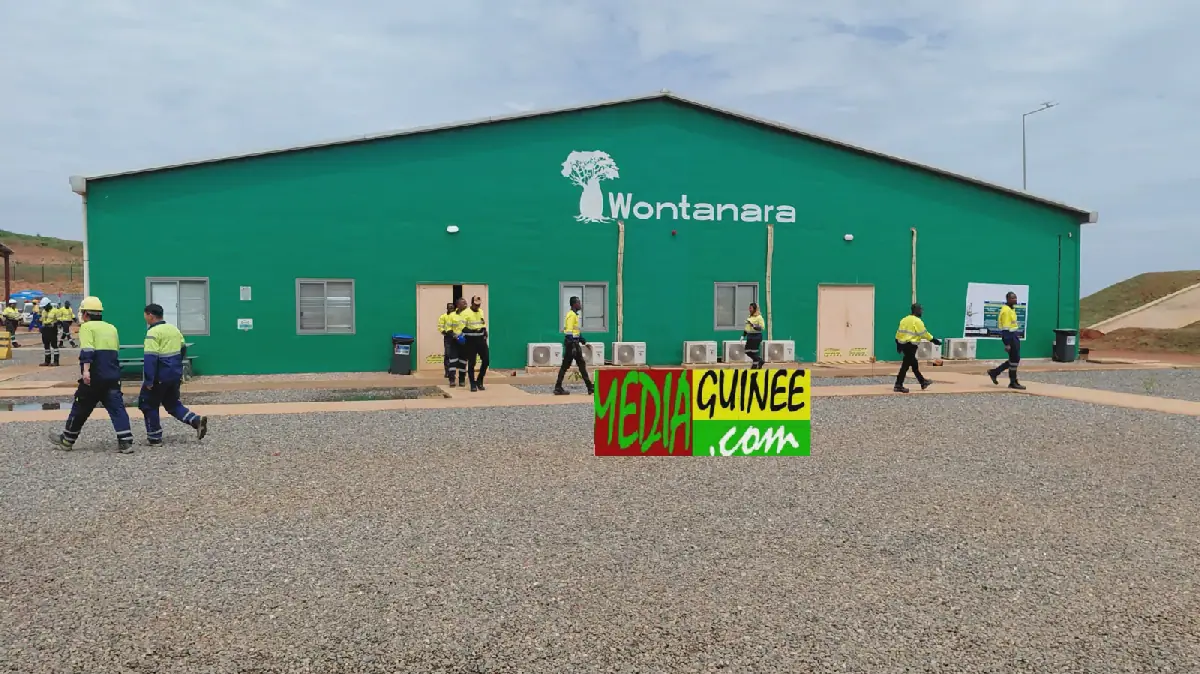
A group of journalists from different Guinean media outlets recently spent two days immersed in the Simandou mining project, courtesy of Rio Tinto Simfer, the operator of blocks 3 and 4 of the project. The tour allowed them to witness firsthand the various stages of iron ore exploitation, from geological work and extraction to processing and loading of wagons that transport the production to the port of Morebaya in Forécariah prefecture. Located in the Simandou mountain range in southeastern Guinea, the mine is one of the world's most significant iron ore deposits.
The two-day immersion aimed to help media professionals understand the project's operations through explanations from several responsible and technical personnel involved in the different stages of the production chain. Zézé Kalivogui, mining geology superintendent, highlighted the unique features of Simandou, describing it as a world-class deposit. He explained that a natural supergene enrichment process contributed to its exceptional quality, shaped over millions of years through weathering and groundwater circulation.
According to Kalivogui, Rio Tinto acquired the permit in 1997, and extensive research has been conducted on the mountain range, approximately 100 kilometers long. This research included detailed mapping, geophysical surveys, and drilling activities, with over 400 kilometers of drilling conducted to date. The drilling operations are accompanied by significant sampling and analysis work, with samples taken every two meters for detailed studies.
The journalists also visited the Sabaty training center, which provides training for local workers in various professions and operational requirements of the project. Mamadi Condé, training superintendent at Simfer, presented the different components of this infrastructure, which trains between 500 and 700 learners per week from impacted communities. The center features several practical and theoretical learning spaces, including six simulation cabins for familiarizing workers with operating different machinery.
The tour continued with a visit to the mineral crushing and processing facilities, where Mohamed Fodé Condé, crushing supervisor, explained the operation of equipment designed to progressively reduce the size of iron ore blocks. The process begins with primary crushing, followed by transportation via conveyor belts and further processing through secondary crushers. These operations prepare the mineral according to the expected granulometric characteristics for the next stage of production.
The final phase of the visit involved discovering the preparation and loading of mineral into trains. Georges Guilavogui, mining engineer and deputy project director at GPC, explained the mechanism in place to supply the trains. He described the process of transporting mineral from a storage area called IOS to the TLO, where preparation and loading of wagons take place. Equipment called scalpers is used to sort the mineral to recover fine particles meeting the required specifications.
The Simandou project is a significant development for Guinea, with the potential to boost the country's economy through the exploitation of its rich natural resources. The project involves collaboration between Rio Tinto Simfer and local authorities to ensure that the benefits of the mine are shared equitably among stakeholders. The journalists' tour demonstrates the importance of transparency and communication in the mining sector, allowing the public to better understand the complexities of large-scale mining operations.
Key points
- The Simandou mine is one of the world's most significant iron ore deposits, with a unique geological formation that contributes to its exceptional quality.
- The project involves extensive research and drilling activities, with over 400 kilometers of drilling conducted to date.
- The Sabaty training center provides training for local workers in various professions and operational requirements of the project, with between 500 and 700 learners per week.