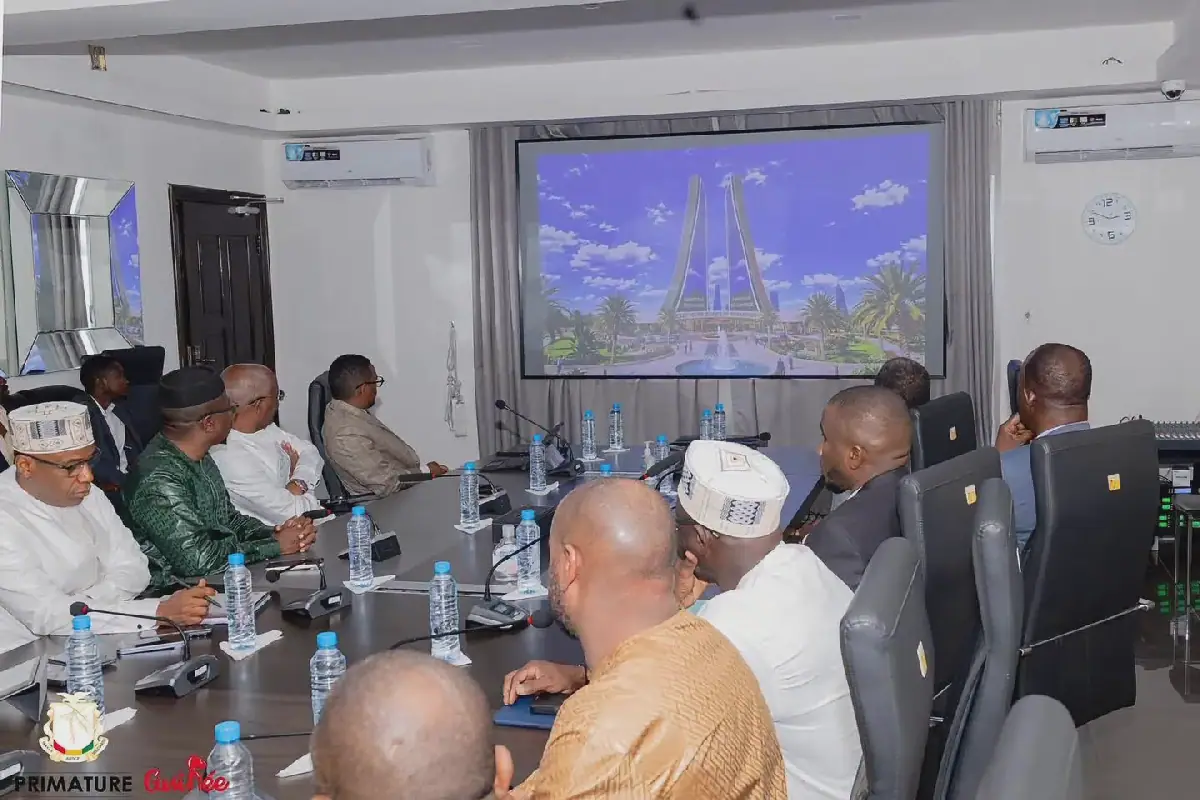
The government of Guinea has been presented with a proposal for a new administrative capital, Nimba, by Senegalese architect Pierre Goudiaby ATEPA's group, ATEPA. The project, which covers an area of 30,000 hectares, aims to create a new administrative, economic, industrial, and residential hub in line with the country's Simandou 2040 vision. The plan includes seven main areas: an international airport, an administrative city, a residential zone, an agro-industrial zone, an industrial zone, a presidential palace, and solar fields.
The Nimba project is designed to address the projected doubling of Africa's urban population over the next 20 years. ATEPA's president, Pierre Goudiaby ATEPA, justified the initiative by citing demographic projections that forecast a significant increase in the population of African capitals. The group is also exploring similar projects in Côte d'Ivoire, Gabon, and Sierra Leone. The project's proponents believe that Nimba can become a model for sustainable urban development in Africa.
The proposed capital will be structured around seven main poles, including a 4,000-hectare international airport zone with a 4,000-meter runway, a 5,000-hectare industrial zone linked to the port of Moribaya, and over 1,000 hectares of solar fields. The project's design aims to create an integrated city that combines administrative, residential, agricultural, industrial, and energy functions. This integrated approach is expected to make Nimba a hub for economic growth and development in Guinea.
The estimated cost of the project is between 20 and 30 billion euros over 20 years. According to ATEPA, the financing model is based on two main levers: land valuation and financial structuring. The project's proponents believe that the creation of a new capital will increase land values, which can be used to finance infrastructure development. ATEPA has identified potential partner banks that are willing to support the project's implementation.
The Guinean government has welcomed the proposal, with Prime Minister Amadou Oury Bah expressing enthusiasm for the project's ambition and potential to improve the country's urban landscape. The government has emphasized the need for further studies to ensure the project's economic viability and coherence with the Simandou 2040 vision. The project's realization will depend on various factors, including its precise location, implementation timeline, and financing modalities.
The Nimba project aligns with President Mamadi Doumbouya's vision for Guinea's development by 2040. The government's focus on securing sites for future public infrastructure, including the new administrative capital, is part of a broader effort to drive economic growth and improve living standards. The project's success will depend on careful planning, stakeholder engagement, and effective implementation.
While the project is still in the study and discussion phase, it has generated significant interest and anticipation. If realized, Nimba could become a model for sustainable urban development in Africa and a key driver of economic growth in Guinea. The project's proponents are optimistic about its potential to transform the country's urban landscape and improve the lives of its citizens.
Key points
- The project aims to create a new administrative, economic, industrial, and residential hub in line with Guinea's Simandou 2040 vision.
- The estimated cost of the project is between 20 and 30 billion euros over 20 years.
- The project's design aims to create an integrated city that combines administrative, residential, agricultural, industrial, and energy functions.