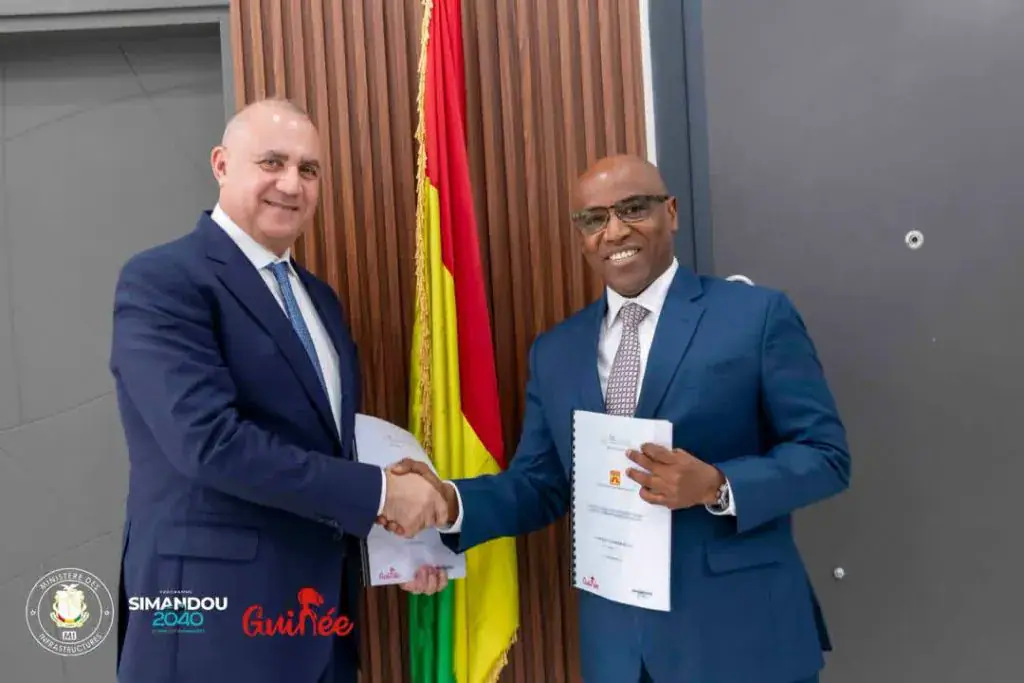
The government of Guinea has taken a significant step forward in its plan to develop a coastal road connecting Kipé to Dubréka. On November 27, 2026, Infrastructure Minister Facinet Sylla signed a commercial contract with Hitech Construction Company Ltd, represented by its general director, Dany Abboud. The project involves building a 26.3km road, including 10km along the coast, to improve mobility in Conakry.
The coastal road project is one of the most ambitious infrastructure plans announced for the Conakry agglomeration. The road will be a two-lane, two-way highway with two bridges for crossing estuary arms, four roundabouts, and coastal protection works along the entire route. The project was prepared over several months with Hitech Construction, and the contract signing follows a meeting between Minister Sylla and the company's officials in Nigeria in May 2026.
The financial aspect of the project is significant, with an estimated cost of $1.55 billion, according to the Guinea Development Board (GDB). The project is expected to be implemented as a public-private partnership (PPP). However, the exact contract value and financial arrangements have not been officially confirmed. The project's sustainability will depend on clarifying the final cost, financial commitments, and repayment or investment returns.
One of the main objectives of the coastal road is to reduce congestion in Conakry by providing an alternative route between the northern part of the city and Dubréka. The new axis is expected to improve traffic flow, facilitate commercial exchanges, and support urban and economic growth in the Dubréka area. This is crucial, given the increasing demand for transportation infrastructure due to Conakry's demographic and economic development.
The project's technical challenges should not be underestimated, particularly the construction of 10km of road along the coast. This will require in-depth geotechnical, hydrological, and environmental studies to ensure the stability of the foundations and the durability of the infrastructure. Coastal protection works and devices to prevent erosion and mitigate the impact of marine phenomena will be essential.
While the contract signing marks progress, several key details remain unclear, including the exact cost, financial arrangements, execution schedule, and start date. Transparency on financing, contractual commitments, environmental studies, and monitoring mechanisms will be vital to ensure the project's success and allow the public to track its progress.
The Conakry-Dubréka coastal road project is part of Guinea's efforts to modernize its transportation infrastructure and support the development of the capital and surrounding areas. If completed, the road could become a key axis for territorial planning, provided that the announced commitments translate into effective implementation, respecting quality, safety, and environmental protection requirements.
Key points
- The project aims to reduce congestion in Conakry by providing an alternative route between the northern part of the city and Dubréka.
- The estimated cost of the project is $1.55 billion, to be implemented as a public-private partnership.
- The project involves building a 26.3km road, including 10km along the coast, with two bridges, four roundabouts, and coastal protection works.