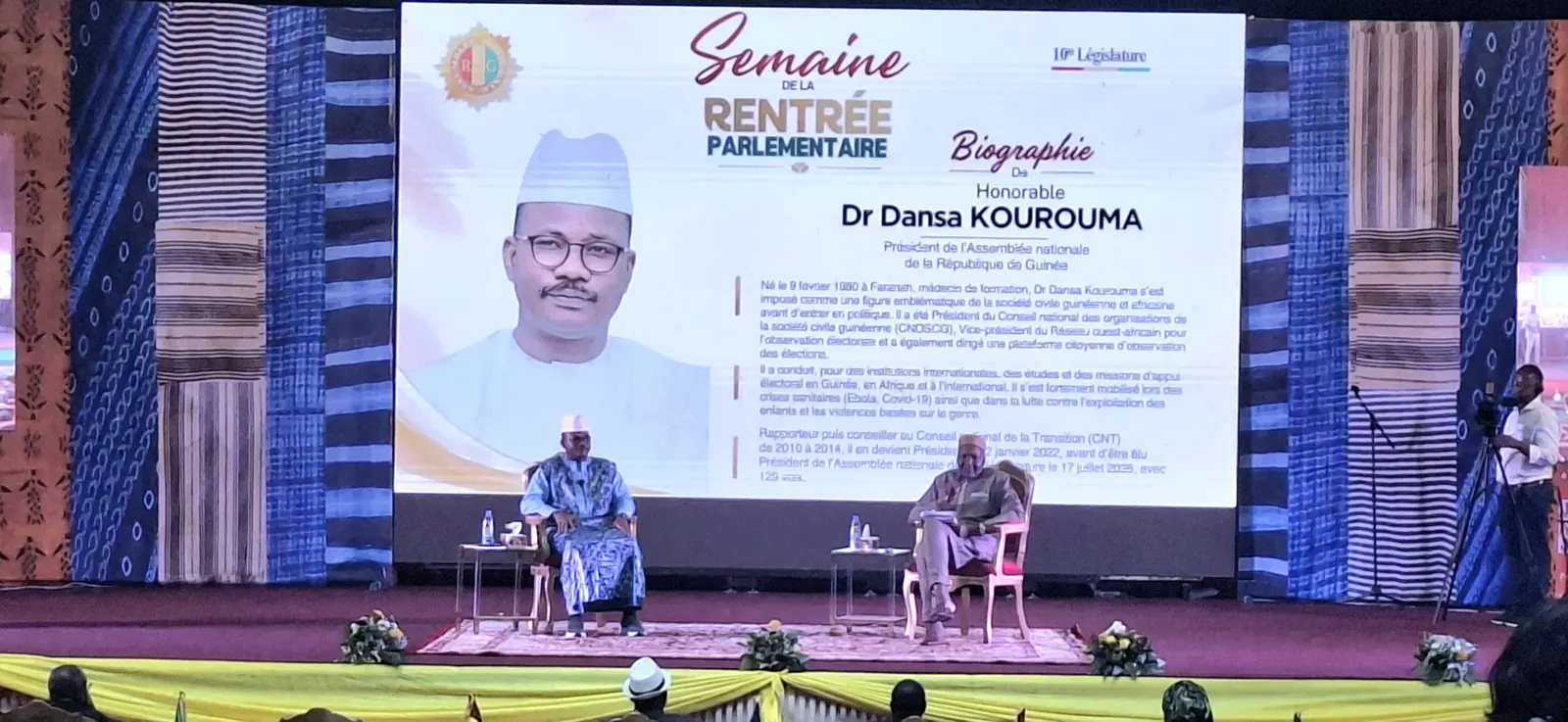
Guinea's National Assembly President, Dr. Dansa Kourouma, recently addressed a seminar for parliamentarians, government representatives, civil society, and academics. He discussed the importance of effective legislation and policy evaluation, highlighting the need for a change in approach. The current focus is shifting from simply voting on laws to rigorously evaluating their direct impact on citizens. This new approach aims to ensure that laws passed by the parliament have a tangible effect on the population.
Dr. Kourouma emphasized that having a constitution is not enough. He noted that the hierarchy of norms is crucial, with the constitution setting fundamental rules for the state. However, these rules must be complemented by organic laws that structure institutions. He reported that out of thirty planned organic laws, twenty have already been drafted. The president stressed that a well-written law is ineffective without popular appropriation and administrative application.
The phenomenon of "fictions juridiques" – laws that are regularly voted on and promulgated but fail to produce effects due to a lack of application decrees – was criticized by Dr. Kourouma. He emphasized the need for laws to be enforceable and effective. The president outlined the four pillars of parliamentary mandate: legislating, representing the nation, controlling government action, and evaluating public policies. He particularly highlighted the often-neglected mission of evaluating public policies.
According to Dr. Kourouma, the value of a law lies not in the volume of texts adopted but in its ability to generate qualitative change in people's daily lives. He cited access to healthcare, clean water, education, and environmental preservation as examples. The president stated that evaluating public policy is an essential tool for the National Assembly to ensure that passed laws have a tangible impact on citizens.
Dr. Kourouma detailed the need for two complementary approaches: ex ante evaluation, which involves prior diagnosis and impact studies provided by the government before examining a bill, and post ante evaluation, which measures the real effects of a law after it comes into force. He emphasized that this approach will enable the parliament to assess the effectiveness of laws and make informed decisions.
The president addressed the elected officials directly, demystifying the parliamentary function. He stressed that a deputy's strength lies in their connection to the population and their ability to represent their aspirations. Dr. Kourouma reassured that technical expertise can be provided by parliamentary administration, expert cabinets, or civil society. He called for scrupulous respect for administrative and legislative procedures.
In conclusion, Dr. Kourouma reminded parliamentarians of the central question that should guide each vote: what situation do they want to modify, for whose benefit, and according to what indicators can they verify that the parliamentary intervention has achieved its objective? This approach aims to establish a result-oriented parliamentarism.
Key points
- Dr. Dansa Kourouma emphasizes the need for a change in approach, shifting from simply voting on laws to rigorously evaluating their direct impact on citizens.
- The president highlights the importance of evaluating public policies to ensure that passed laws have a tangible impact on citizens.
- Dr. Kourouma calls for scrupulous respect for administrative and legislative procedures to ensure effective legislation.