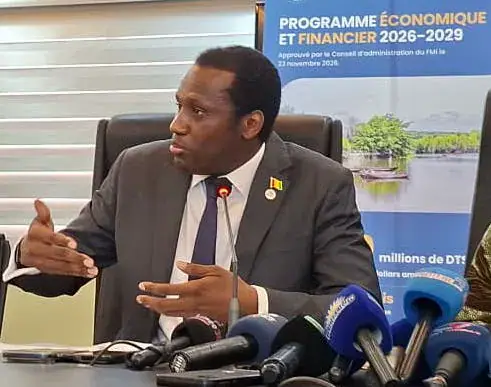
On November 27, 2026, Karamo Kaba, Governor of the Central Bank of the Republic of Guinea (BCRG), held a press conference in Conakry to clarify the nature of the country's new economic and financial program with the International Monetary Fund (IMF). The program, approved by the IMF's Board of Directors, covers the period 2026-2029 and includes a financial support package of 310.59 million Special Drawing Rights (SDRs), equivalent to approximately $425 million.
The three-year program is mobilized through two IMF instruments: the Extended Credit Facility (ECF) and the Extended Credit Mechanism (ECM). Governor Kaba expressed satisfaction with the program's approval, highlighting the extensive technical preparations conducted jointly by Guinean authorities before the dossier's validation. He thanked the IMF and Guinean teams involved in the process, acknowledging the significant efforts made to reach this point.
A key aspect of Governor Kaba's statement was the reaffirmation of Guinea's monetary sovereignty. He emphasized that the IMF will not dictate the country's monetary policy, stressing that Guinean teams will continue to make decisions on this front, with the BCRG leading the way. This clarification aims to dispel any misconceptions about the IMF's role in Guinea's economic governance.
According to Governor Kaba, the IMF's role is limited to providing technical and financial support, as well as monitoring the implementation of agreed-upon commitments. He described the IMF as a partner in the program, rather than a decision-maker. This characterization is intended to provide clarity on the nature of the partnership between Guinea and the IMF.
The new program aims to support Guinea's economic development over the next three years. The financial support provided by the IMF will help the country address its economic challenges and implement reforms to promote sustainable growth. Governor Kaba's statements underscore the importance of transparency and clear communication in the implementation of the program.
The approval of the program marks a significant milestone in Guinea's economic development. The country has been working closely with the IMF to strengthen its economic fundamentals and improve its business environment. The program's success will depend on the effective implementation of reforms and the continued support of international partners.
The Guinean government and the BCRG will continue to work together to ensure the successful implementation of the program. Governor Kaba's clarification on the IMF's role in Guinea's monetary policy aims to promote understanding and transparency, both domestically and internationally. The program's outcomes will be closely monitored by the IMF and other stakeholders.
Key points
- The IMF will provide $425 million in financial support to Guinea over three years.
- Guinea's Central Bank Governor emphasizes the country's monetary sovereignty.
- The IMF's role is limited to technical and financial support, as well as monitoring.