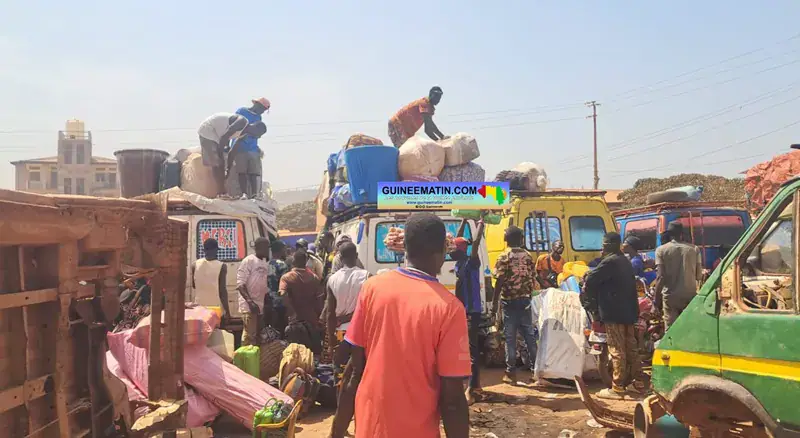
The Guinean government's decision to ban artisanal and anarchic gold exploitation in the Siguiri administrative region has started to take effect. In Kintinian, particularly in Bouré Nafadji and other mining areas, thousands of miners and their families are departing for their villages and original prefectures. The ban, announced on November 2, 2026, aims to stop environmental damage caused by the activity, including soil degradation, agricultural land destruction, and water pollution.
The ban has left many workers without a source of income, forcing them to return to their hometowns. Mohamed Camara, a native of Kissidougou, said he has no choice but to go back home after the ban. "We are leaving for Kissidougou because artisanal gold mining is banned. We depend on it for our livelihood, and I have no other skills," he said. Camara had abandoned his studies in 2016 and started mining, eventually earning 10 million Guinean francs in 2018.
The situation is dire for households with no alternative income sources. Nafina Traoré, a native of Faranah, is leaving Kintinian with her family, citing desperation. "We are in difficulty, my husband and I have nothing, and our children go hungry. I ask President Mamadi Doumbouya to help women like us. We have suffered a lot," she said. Her family relies on support from their parents to survive.
Some miners are choosing to leave Kintinian before exhausting their savings. Abou Touré said he prefers to leave rather than wait for government assistance. "I want to leave Kintinian because artisanal gold mining is banned. I don't want to finish my money, and my family is large. I am poor," he explained. Moussa Traoré, also from Kissidougou, shares a similar sentiment. "I came to find money, but now I am leaving with almost nothing. It's better to return home."
The ban has significant social implications, affecting not only miners but also their families and the local economy. Many workers say they cannot wait for government initiatives, including census operations and socioeconomic reconversion programs. The situation raises questions about supporting thousands of people whose livelihoods depended on artisanal gold mining.
The Guinean government had announced measures to mitigate the impact of the ban, including agricultural sector initiatives. However, many miners say they lack the resources to wait for these programs to materialize. As the population departs, the issue of environmental protection becomes intertwined with finding sustainable solutions for communities that relied on artisanal gold mining.
The mass exodus from Kintinian highlights the challenges of balancing environmental protection with socioeconomic concerns. As the government implements its ban, it must also address the needs of affected communities. The story of thousands of miners and their families serves as a testament to the complexities of sustainable development in Guinea's mining regions.
Key points
- The Guinean government's ban on artisanal gold mining has led to a mass exodus of thousands of miners and their families from the Kintinian region.
- The ban aims to stop environmental damage but has significant social implications, with many workers lacking alternative income sources.
- The situation raises questions about supporting affected communities and finding sustainable solutions that balance environmental protection with socioeconomic concerns.