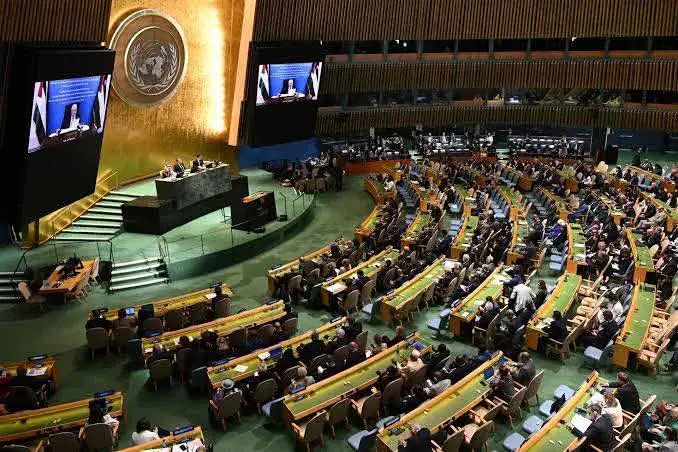
The Guinean government's decision to abstain from a recent UN vote on a resolution against colonialism has raised eyebrows among international observers. The vote, which took place on October 15, 2026, was part of the Fourth Committee of the UN General Assembly. The resolution, titled "Combating Contemporary Forms of Colonialism," aimed to address ongoing issues of colonialism around the world. Guinea, a country with a long history of fighting against colonialism, chose not to participate in the vote.
Guinea's historical stance on colonialism is well-documented. In 1958, under the leadership of Ahmed Sékou Touré, Guinea became the only French colony to vote "no" to a referendum proposed by Charles de Gaulle, opting for independence instead. This decision has since become a cornerstone of the country's national identity. As such, Guinea has traditionally supported UN resolutions on decolonization, making its abstention from this particular vote all the more surprising.
In recent months, Guinea has taken steps to reaffirm its commitment to anti-colonialism. In September 2026, the country adopted its first official foreign policy doctrine, which emphasizes pan-Africanism and sovereignty. Additionally, in July, Guinea formally requested that France return the manuscripts of Samori Touré and the remains of Bokara Biro, with the repatriation scheduled for 2027. These actions seem to contradict the country's abstention from the UN vote.
The abstention has also raised questions about Guinea's stance on territorial disputes with neighboring countries. The country has ongoing border disputes with Liberia and Sierra Leone, and has invoked a colonial-era treaty with Liberia to support its claims. While the international community recognizes the continuity of borders, Guinea's non-participation in the anti-colonialism resolution may be seen as a reluctance to challenge the legitimacy of such instruments in its own disputes.
The Guinean Ministry of Foreign Affairs has yet to provide a clear explanation for the country's abstention from the UN vote. Given the government's efforts to establish its legitimacy on the international stage, particularly since taking power in 2021, transparency on this issue is crucial. The silence surrounding the abstention may speak louder than words, and it is essential that the government provides a clear and relevant explanation.
Guinea's actions have sparked concerns about potential conflicts of interest and diplomatic strategy. While the country's commitment to pan-Africanism and sovereignty is clear, its abstention from the UN vote has created ambiguity. As the country continues to navigate its relationships with international partners, it is essential that it provides clarity on its position regarding colonialism and its implications for its foreign policy.
Ultimately, Guinea's abstention from the UN vote on colonialism has raised important questions about the country's diplomatic strategy and its commitment to anti-colonialism. As the international community continues to address ongoing issues of colonialism, Guinea's position on these issues will be closely watched. The country's response to these concerns will be crucial in determining its future relationships with international partners and its role in global affairs.
Key points
- The Guinean government's abstention from the UN vote on colonialism has sparked questions about its diplomatic strategy and potential conflicts of interest.
- Guinea's historical stance on colonialism and its recent actions seem to contradict its abstention from the UN vote.
- The country's response to these concerns will be crucial in determining its future relationships with international partners and its role in global affairs.