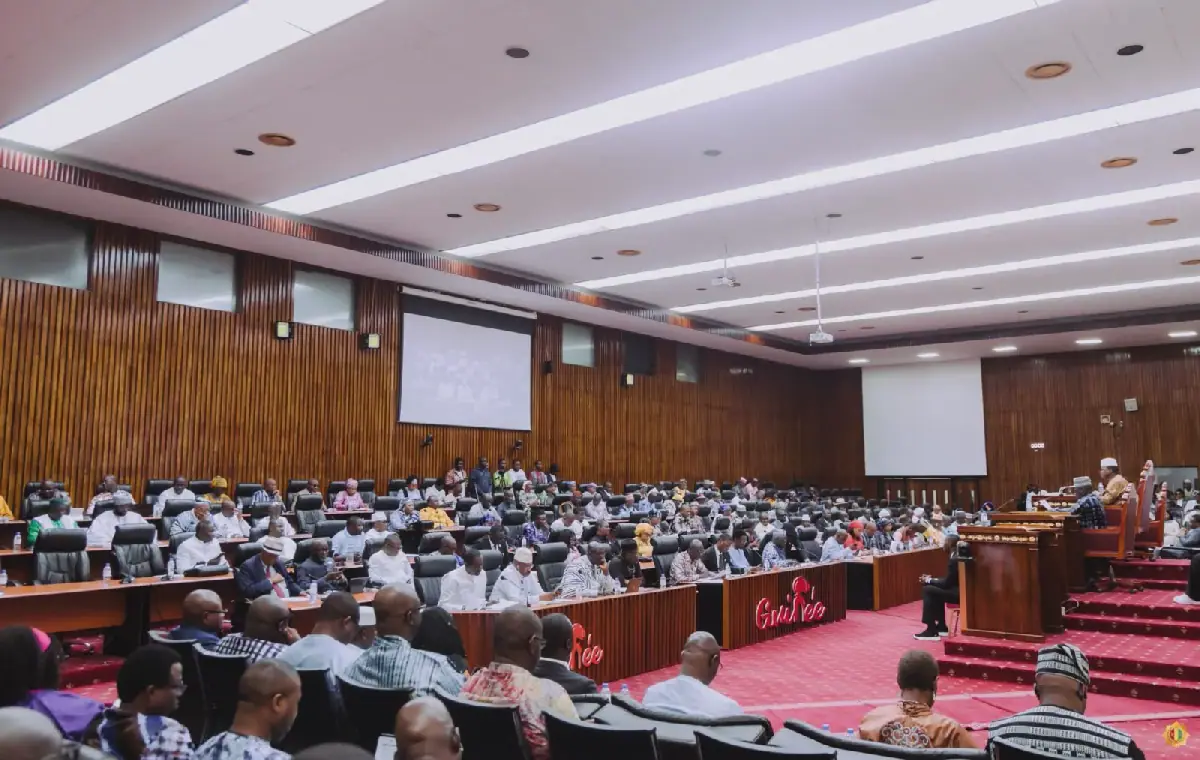
The Guinean National Assembly has expressed concerns over the slow execution of investments in the country's 2026 revised budget. According to a report by the Assembly's Economic and Financial Affairs Committee, 29 out of 39 departments and institutions have a payment rate of less than 30%. This has raised concerns among lawmakers about the effectiveness of public policy implementation. The committee's report highlights several shortcomings in public finance management.
The revised budget, which was examined from November 1 to 5, reveals a 5.83% increase in state expenditures, reaching 67,925.87 billion Guinean francs. However, investment spending has decreased by 10.13% to 23,562.27 billion francs. The low execution rate of investments has sparked concerns among parliamentarians, who attribute this to inadequacies in project planning, preparation, and execution. The Assembly has called on the Prime Minister to conduct an in-depth evaluation to identify responsible parties and correct dysfunctions.
The situation of administrative public establishments (EPA) is also a cause for concern. According to the report, 33 establishments have a zero payment rate, just a month before the end of the expenditure chain. This affects workers who have not received their salaries for several months. The Assembly has urged the government to take urgent measures to regularize these payments and secure credits for remuneration. The parliamentarians also expressed concerns about the slow pace of domestic debt repayment.
On the domestic debt, the report notes that out of an audited stock of 1,700 billion francs, several validated claims remain unpaid. The Assembly has asked the Ministry of Finance to accelerate the settlement of recognized debts, deeming it essential for preserving private company liquidity and supporting economic activity. In the agricultural sector, the situation is equally worrying, with no funds allocated for rural road construction.
The report also highlights issues with local government financing. Out of 2,316 billion francs collected by the Treasury, only 15.67 billion francs, or 0.65%, were transferred to the National Agency for Local Government Financing (ANAFIC). The Assembly demands an effective transfer of resources to enable local governments to finance their infrastructure and assume their competencies. School canteens are also affected, with no payments made out of the 30 billion francs allocated for their operation.
Furthermore, the Assembly has drawn attention to the weight of subsidies granted to Electricity of Guinea (EDG), estimated at 3,000 billion francs. The parliamentarians recommend a gradual rationalization of these subsidies while inviting the company to improve invoice collection, reduce losses, and accelerate the deployment of prepaid meters. The report also notes that only 176 out of 339 projects listed in the Simandou 2040 Program are included in the revised budget.
The Assembly's Economic and Financial Affairs Committee has formulated several recommendations, including increased transparency in public spending, simplified payment procedures, and the modernization of school and judicial infrastructure. Despite these concerns, the committee has expressed its support for the revised budget and called for its adoption by all deputies. The committee emphasizes the need to transform budget credits into concrete achievements for the benefit of the population.
Key points
- 29 Guinean departments struggle to execute investment credits
- Low execution rate of investments sparks concerns among parliamentarians
- Assembly demands urgent measures to regularize payments to administrative public establishments