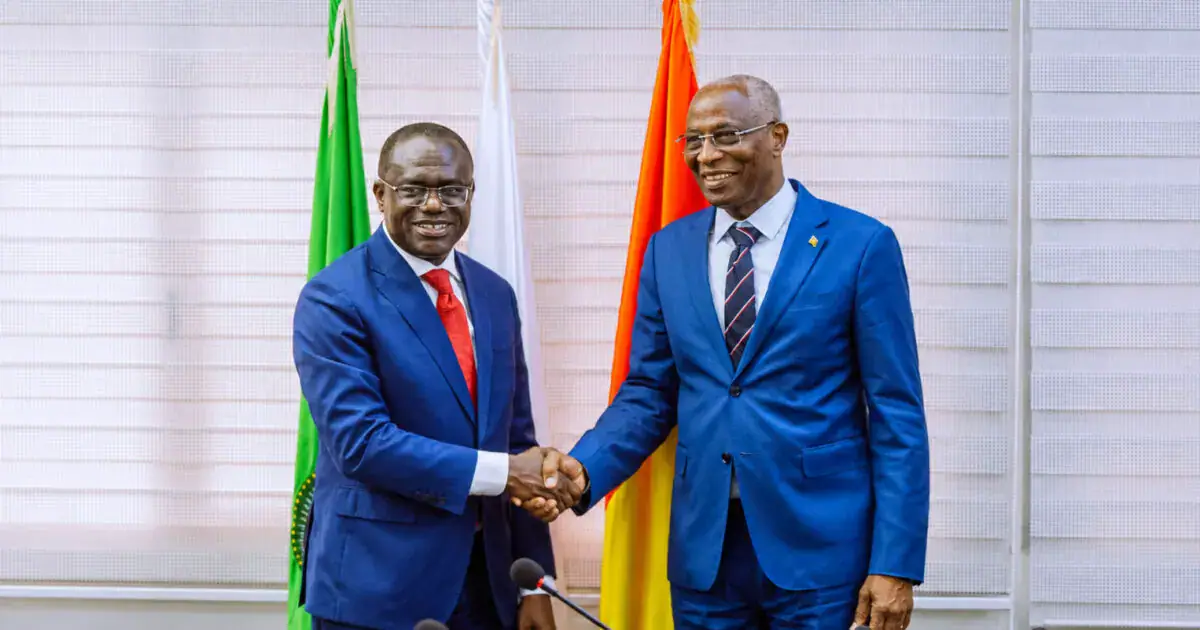
The Prime Minister of Guinea, Amadou Oury Bah, has expressed enthusiasm for a new waste management partnership between the Ghanaian Jospong Group of Companies (JGC) and the Guinean government. He described the partnership as a continuation of the historic ties between Ghana and Guinea, dating back to the days of independence. The partnership aims to establish an integrated, modern municipal waste management system for Conakry, shifting the city from an unsustainable waste disposal model towards a circular sanitation economy.
The agreement, signed on November 3, will see Zoomlion Ghana Limited, through its subsidiary Zoomlion Guinea Integrated Waste Solutions Limited (ZGIWSL), work closely with the Ministry of Sanitation, Hydraulics and Hydrocarbons (MAHH) and the National Agency for Sanitation and Public Health (ANASP). ZGIWSL will manage and operate key transfer stations, organise waste collection in major public markets, and oversee the transportation of waste to the Baritodé landfill and future resource-recovery facilities.
Guinea’s Minister of Sanitation, Hydraulics and Hydrocarbons, Aboubacar Camara, said the partnership marked a major turning point for the country’s sanitation sector, aligning with President Mamadi Doumbouya's vision and priorities. For years, waste collected from Conakry and surrounding areas had been transported and dumped back in the city, prompting the President to close Dar-es-Salam. The Minister noted that Guinea had worked with Jospong for years and described the group as an experienced operator in waste management, recovery, and transformation.
The partnership is expected to create between 2,000 and 3,000 jobs and improve the public perception of sanitation work. Minister Camara thanked Dr Joseph Siaw Agyepong, Executive Chairman of JGC, for committing funds towards the early establishment of a waste processing and recovery plant. He stressed that the project’s success would depend not only on equipment and technical capacity but also on active community participation, with public education and environmental awareness campaigns to be rolled out.
Dr Agyepong conveyed greetings from the President of Ghana and commended President Doumbouya for his vision and commitment to transforming Guinea’s development landscape. He called on African countries to move beyond traditional financing and operational arrangements that had failed to provide sustainable solutions to urban sanitation challenges. Dr Agyepong said the group would bring a self-sustaining, circular industrial model built on localised African capacity to Guinea.
The Jospong Group of Companies operates in 29 countries, has an asset base exceeding $2.4 billion, and employs approximately 10,000 people globally. Dr Agyepong cited the group’s experience in Ghana and its reported $180 million infrastructure investments in Lagos State, Nigeria, as evidence of its capacity to deliver large-scale projects. The machinery and equipment to be deployed in Conakry would be purpose-built to meet local operational requirements.
The project is part of President Doumbouya's Simandou 2040 programme, which includes making the capital clean. Minister Camara linked the project to this programme, saying it was an opportunity that Guinea must seize. With professionalisation and the valuing of sanitation work, many young people currently unemployed will have the chance to participate in the construction of their lives and country.
Key points
- The partnership aims to establish a modern municipal waste management system in Conakry, shifting the city from an unsustainable waste disposal model towards a circular sanitation economy.
- The project is expected to create between 2,000 and 3,000 jobs and improve the public perception of sanitation work.
- The Jospong Group of Companies will bring a self-sustaining, circular industrial model built on localised African capacity to Guinea.