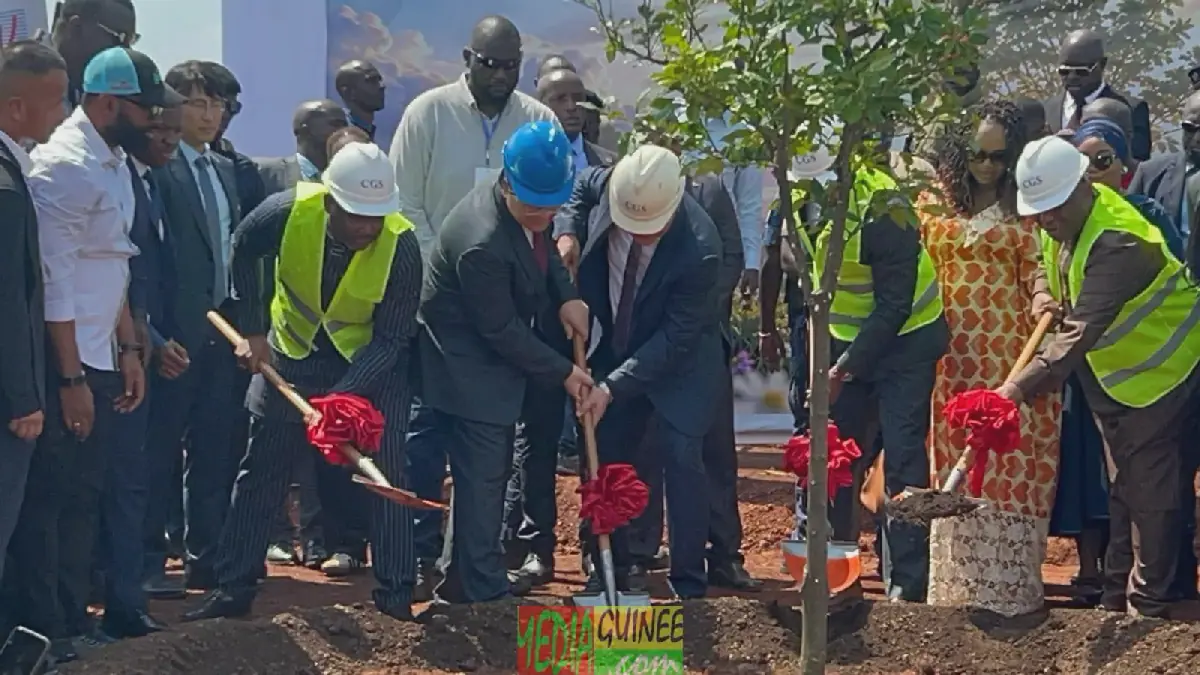
The project to ecologically close and rehabilitate the Dar-es-Salam dump site in Conakry's Gbessia commune was officially launched on November 2, 2026. The ceremony was presided over by Prime Minister Amadou Oury Bah, representing President Mamadi Doumbouya. The project, fully funded by Winning International Group, aims to transform the former dump site into a vegetated urban park. The site has accumulated around 7.2 million tons of waste over nearly three decades.
The launch of the project comes after a tragic landslide on August 23, 2026, which killed 36 people. Local authorities have welcomed the initiative, which they say is long overdue. Gbessia Mayor Mamadou Saliou Fofana praised the launch, highlighting the severe environmental, health, and social consequences of the dump site's prolonged exploitation. He emphasized that the issue goes beyond waste management, involving public health, human dignity, environmental preservation, and social justice.
Winning International Group's President and CEO, Sun Xiushun, confirmed that his company will fully fund the project and donate it to the Guinean people. He stated that the tragedy on August 23 reinforced the urgency of acting to protect the population and improve their environment. Sun Xiushun assured that his group will mobilize its technical expertise to respect international engineering and environmental protection standards.
The dump site covers approximately 280,000 square meters and has received over 9 million cubic meters of waste, equivalent to 7.2 million tons. The site's exploitation has resulted in significant environmental consequences, including methane emissions estimated at 250,000 tons, equivalent to 6 million tons of CO2, and leachate infiltration into the soil, groundwater, and coastal areas.
According to the Ministry of Sanitation, Hydraulics, and Hydrocarbons, between 150,000 and 250,000 people have lived within two kilometers of the dump site, facing daily nuisances and risks from fumes, fires, gases, flies, and rodents. Minister Aboubacar Camara described the situation as an "ecological, health, and environmental catastrophe." He emphasized that closing the site is a crucial step in protecting the population and improving Conakry's living conditions.
The project's technical aspects include stabilizing the waste massif, installing an impermeable cover, a drainage system, and capturing and treating gases. The goal is to reduce the risks of landslides, fires, and pollution before transforming the site into a vegetated urban park open to the public. Minister Camara noted that closing Dar-es-Salam will not be enough to solve Conakry's sanitation problems and advocated for a sustainable financing mechanism for the entire waste management chain.
Prime Minister Amadou Oury Bah announced that he will personally oversee the project's execution, collaborating with relevant departments and local authorities. He linked the initiative to the Simandou 2040 program, emphasizing that development should translate into concrete improvements in citizens' living conditions. The Prime Minister stressed the need for better organization of waste collection, transportation, and treatment in Conakry, as well as reinforced urban risk prevention mechanisms.
Key points
- The project aims to transform the Dar-es-Salam dump site into a vegetated urban park, reducing environmental and health risks for nearby communities.
- The project is fully funded by Winning International Group, which will donate it to the Guinean people.
- The dump site's rehabilitation is expected to improve living conditions for Conakry's residents and mitigate the risks of landslides, fires, and pollution.