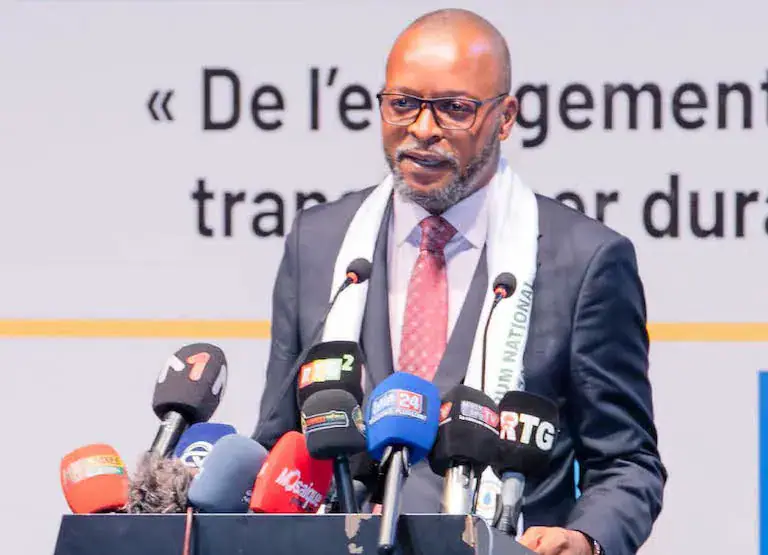
The Forum national de l'assainissement was launched on November 25, 2026, in Conakry, Guinea's capital city. The event, organized by the Ministry of Sanitation, Hydraulics, and Hydrocarbons, brings together several government officials to discuss the country's sanitation challenges. The forum's primary objective is to find sustainable solutions to Guinea's waste management problems. Minister of Sanitation Aboubacar Camara emphasized the need for a deep reform of the sanitation sector.
Minister Aboubacar Camara highlighted the importance of sustainable financing, improved waste collection, and better protection for sanitation workers. He stressed that the country cannot provide a permanent sanitation service with irregular resources. The minister also drew attention to the difficult working conditions faced by sanitation agents, who often lack regular salaries, social protection, and retirement prospects. He argued that those who work to keep cities clean should be able to do so with dignity.
The minister proposed the creation of a national sanitation fund and vocational training centers for hygiene and sanitation professionals. Gilles Fagninou, regional director of UNICEF for West and Central Africa, reaffirmed his institution's commitment to supporting Guinea in its sanitation efforts. Fagninou emphasized that sanitation is not just a matter of waste management but also a question of public health, human dignity, and social justice.
Fagninou urged the need to transform commitments into concrete results, citing the importance of tangible changes in people's lives. He mentioned that success will be measured by the availability of clean schools, well-equipped health centers, and communities that benefit sustainably from sanitation services. The governor of Conakry, General M'Mahawa Sylla, called for collective mobilization to address the challenge of unsanitary conditions in the capital.
General Sylla emphasized that sanitation cannot be the responsibility of a single institution or department, but rather requires the civic engagement of all Guineans. She stressed that each individual must take responsibility for the cleanliness of their environment. The Prime Minister, Amadou Oury Bah, reviewed the actions already taken by the government, including the closure of the Dar-es-Salam landfill and negotiations with waste collection operators.
The Prime Minister announced that equipment for transporting waste to a temporary landfill is expected within two to three weeks. He urged local authorities to better organize waste pre-collection in neighborhoods, which would not only improve city cleanliness but also create jobs for young people. The Prime Minister encouraged the consideration of waste as a source of economic opportunities and wealth creation.
The Prime Minister recalled the President's instructions to make Conakry totally clean by the end of December. He emphasized that the means are being made available to local authorities, who must now organize to achieve this objective. The participants aim to sign a National Pact for Sanitation for Dignity, accompanied by a roadmap defining priority actions for the first 100 days.
Key points
- The Guinean government aims to improve sanitation services and create jobs through sustainable waste management practices.
- The national forum on sanitation seeks to address the country's waste management challenges and improve living conditions for its citizens.
- The government plans to create a national sanitation fund and vocational training centers for hygiene and sanitation professionals.