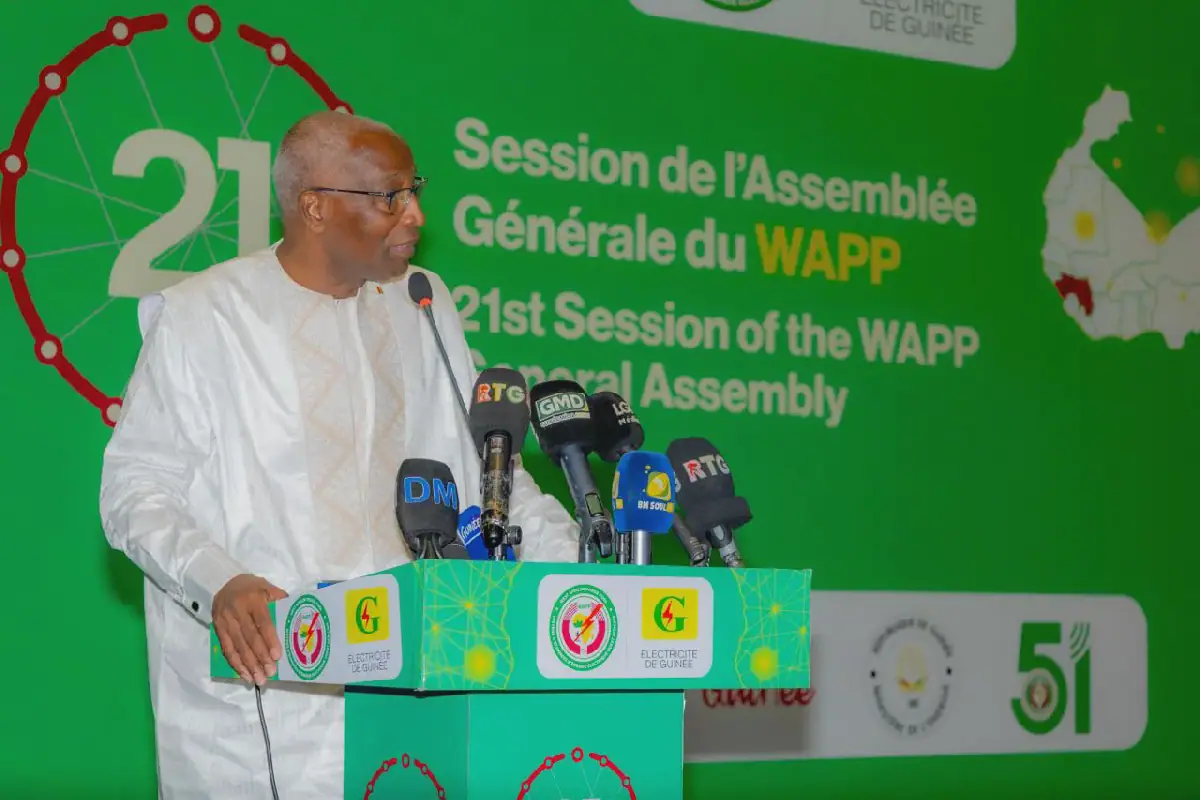
The 21st Ordinary General Assembly of the West African Power Pool (WAPP) has commenced in Conakry, Guinea, bringing together delegates from Economic Community of West African States (ECOWAS) member states, national electricity companies, independent producers, and technical and financial partners. The gathering aims to address the region's energy challenges and opportunities. Prime Minister Bah Oury presided over the opening ceremony, welcoming the diverse range of participants. He expressed the Guinean government's gratitude for being chosen to host this significant sub-regional meeting.
Prime Minister Bah Oury emphasized the strategic importance of energy in national development, stating that it underpins sovereignty, competitiveness, social progress, and state stability. He noted that electricity is more than just an economic service or technical infrastructure, as it directly impacts a nation's ability to produce, transform its economy, create jobs, and improve living standards. The Prime Minister highlighted that no country can achieve successful industrialization without a reliable and accessible energy system.
The Prime Minister stressed that energy should not be viewed solely as an economic service or technical infrastructure. Instead, it is a critical factor in determining a nation's competitiveness, social progress, and stability. He urged the need for collective responsibility in making electricity a driver of economic transformation, wealth creation, and improved well-being for the population. The Prime Minister also acknowledged the progress made in regional energy cooperation, particularly the establishment of an electricity exchange network connecting the 15 West African states.
Bah Oury called for the consolidation of these achievements and continued efforts toward regional integration. He encouraged the participants to prioritize energy mastery as a strategic imperative, pooling their efforts to ensure a reliable and efficient electricity supply. The Prime Minister expressed optimism about the potential for energy to drive regional emergence and integration, citing the presence of all 15 ECOWAS member states at the assembly as evidence of successful dynamics.
The WAPP assembly provides a platform for stakeholders to discuss and address the complex issues facing the region's energy sector. The meeting is expected to foster collaboration and coordination among member states, leading to more effective management of energy resources and improved electricity services. The Guinean government's hosting of the assembly demonstrates its commitment to regional cooperation and energy development.
The assembly's discussions will likely focus on strategies for enhancing energy access, reliability, and sustainability in West Africa. Participants will explore ways to leverage the region's energy potential, address infrastructure gaps, and promote investment in the sector. The outcome of the meeting is expected to contribute to the development of a more integrated and effective regional energy market.
The West African Power Pool (WAPP) plays a crucial role in promoting regional energy cooperation and integration. The organization aims to create a unified energy market, facilitating the exchange of electricity and promoting economic development in the region. The 21st WAPP assembly in Conakry will help shape the future of energy in West Africa, with implications for the region's economic growth, social progress, and environmental sustainability.
Key points
- Energy is critical to national sovereignty, competitiveness, and social progress.