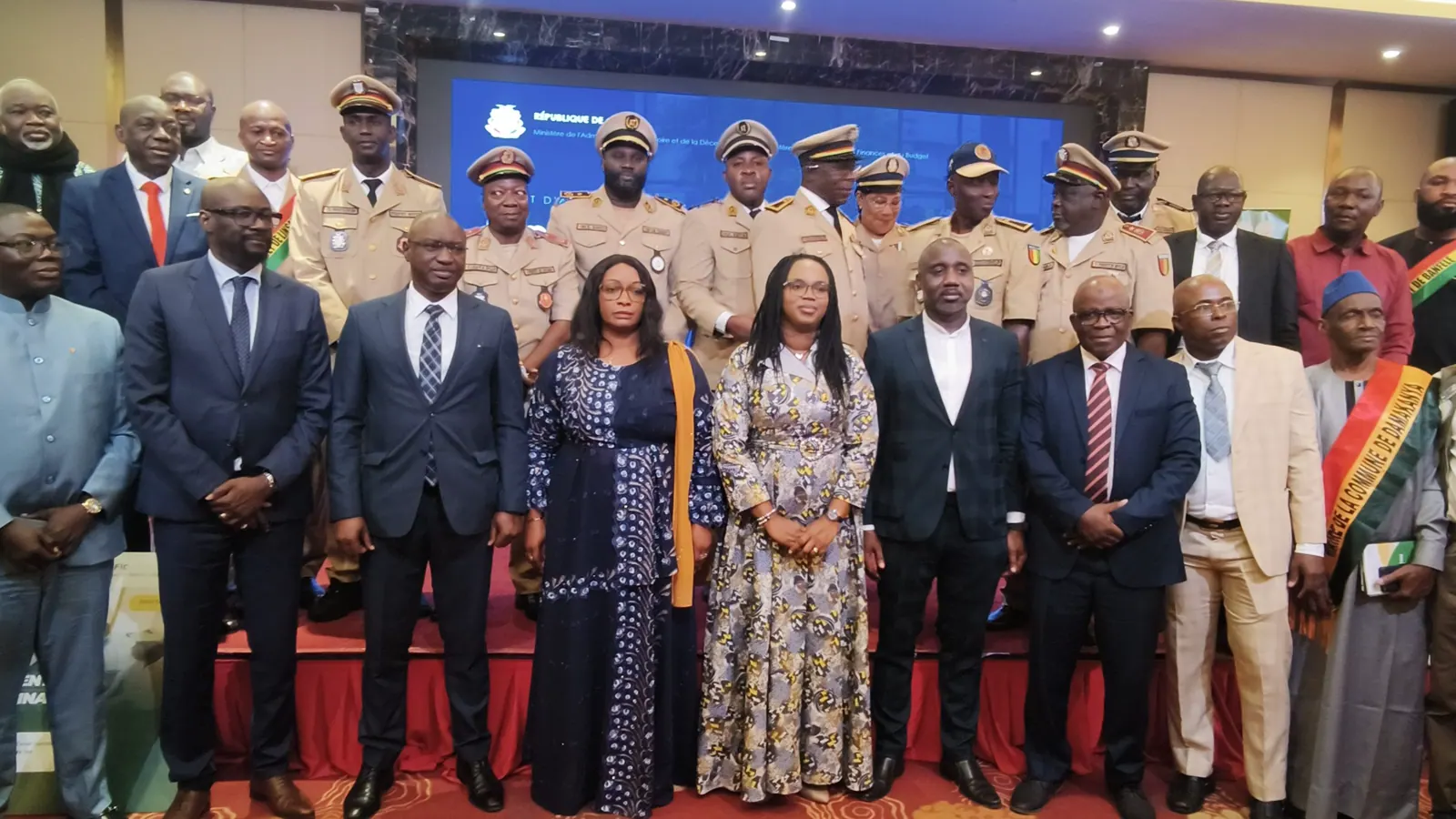
The Guinean government, alongside the Agence nationale de financement des collectivités locales (ANAFIC) and the Agence française de développement (AFD), recently convened to assess the achievements of the Projet d’appui à l’ANAFIC (PANAFIC). This project is part of a broader policy to strengthen the capacities of decentralized entities and enhance local financing mechanisms. According to Sékou M’Mawa Touré, director general of ANAFIC, the PANAFIC project aligns with the government's goal to improve public action proximity to the population.
The PANAFIC project aims to support Guinea's decentralization efforts by enhancing the capacities of local entities and improving financing mechanisms for local development. Sékou M’Mawa Touré emphasized that the project's evaluation is not limited to achievements but also involves identifying effective practices, understanding encountered constraints, and proposing future improvements. He highlighted the need to assess the efficacy of established mechanisms, investment quality, capacity reinforcement, and sustainability of achievements.
Moussa Doumbouya, representing the Agence française de développement, noted that ANAFIC originated as a project supporting village collectives, established in the 1990s. After years of accompaniment by technical and financial partners, the government institutionalized it between 2017 and 2019, leading to the creation of ANAFIC. Doumbouya stated that PANAFIC has been a global success, reaching Guinea's most remote territories and strengthening ANAFIC and local collectives' capacities.
The PANAFIC project has made significant strides, with over five million people, mostly women, benefiting directly or indirectly from its actions. Minister of Territorial Administration and Decentralization, Djenabou Touré, reported that the project utilized the entire allocated ten million euros and achieved most of its objectives. She cited the realization of around a hundred micro-projects, including schools, health centers, and water points, as well as equipment for decentralized collectives.
Despite the accomplishments, Djenabou Touré acknowledged that several challenges persist, such as low female participation in decision-making instances, insufficient progression in collecting local resources, and difficulties in the communal accounting chain. She stressed the need for learning from successes and failures, and called for regular allocation to special allocation budgets of the Fonds national de développement local (FNDL) and the Fonds de développement économique local (FODEL).
The workshop also featured the distribution of computer kits, electronic payment terminals, and motorcycles, as well as presentations on PANAFIC's objectives, components, execution rate, and investments. Participants analyzed results, discrepancies, and project perspectives through plenary exchanges. The minister emphasized that sustaining achievements depends on the commitment of the government, central and deconcentrated administration, local collectives, elected officials, and partners.
The PANAFIC project's experience could serve as a reference for future interventions in favor of decentralization and local development, particularly in the context of the Simandou 2040 program. Sékou M’Mawa Touré believes that better-organized collectives capable of planning investments will be essential to accompany the country's economic and social transformations.
Key points
- The PANAFIC project achieved most of its objectives, utilizing the entire allocated ten million euros and benefiting over five million people.
- Despite accomplishments, challenges persist, including low female participation in decision-making and difficulties in the communal accounting chain.
- The project's experience could serve as a reference for future interventions in favor of decentralization and local development.