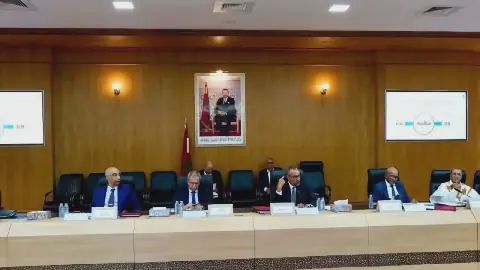
The Court of Repression of Economic and Financial Infractions (CRIEF) in Guinea has resumed its hearings after a two-month recess. On its first day back, the court examined two cases, including one involving nine individuals, some of whom hold positions in the government, particularly in the Ministry of Mines and Geology. The defendants, including Bachir Camara, Saïdou Sampil, and Karamoko Soumah, are accused of corruption in the public and private sectors, environmental damage, association of wrongdoing, and complicity.
The case centers around the alleged dumping of 7,502 tonnes of ore at sea following the capsizing of a ship owned by Bel Air Mining in 2023. The company was reportedly required to pay a fine of 20 billion Guinean francs related to the incident. An inspection team led by the Inspector General of Mines and Geology was sent to investigate and monitor the case. The management of funds corresponding to the alleged fine has also become a point of contention, with questions raised about why the amount was not directly deposited into the public treasury but instead transited through the Central Bank of the Republic of Guinea.
The defendants in the case include high-ranking officials and individuals from various sectors. They are accused of involvement in a range of alleged offenses, including corruption and environmental damage. The case has garnered significant attention due to the high-profile nature of some of the accused and the substantial fine involved. The CRIEF court has been tasked with unraveling the complexities of the case and determining the extent of each defendant's involvement.
During the hearing, some defendants were present, while others were absent. The defense lawyers requested a postponement of the trial to allow all defendants to be present. They cited the case of Karamoko Soumah, who was allegedly required to travel abroad to represent the Minister of Mines and Geology. However, the prosecution opposed the request, arguing that the absence of one defendant should not delay the entire trial.
After considering the arguments from both sides, the court decided to adjourn the case until October 26, 2026. On this date, the court expects all defendants to be present. The case will continue to be monitored by the CRIEF chamber, which will further examine the facts and evidence presented. The court's decision to adjourn the case has given the defense and prosecution additional time to prepare and ensure that all parties are present.
The case has significant implications for Guinea's efforts to combat corruption and ensure environmental accountability. The involvement of high-ranking officials and the substantial fine at stake underscore the importance of the case. The CRIEF court's handling of the case will be closely watched, both domestically and internationally, as it seeks to address allegations of corruption and environmental damage.
The trial's outcome could have far-reaching consequences for those involved and for Guinea's broader efforts to promote transparency and accountability. The court's decision to adjourn the case until October 26, 2026, has set a clear timeline for the next stage of proceedings. All parties will be required to present their cases and evidence on the designated date, and the court will then determine the next course of action.
Key points
- Nine individuals, including Guinea's Inspector General of Mines, face trial for alleged corruption and environmental damage related to the dumping of 7,502 tonnes of ore at sea.