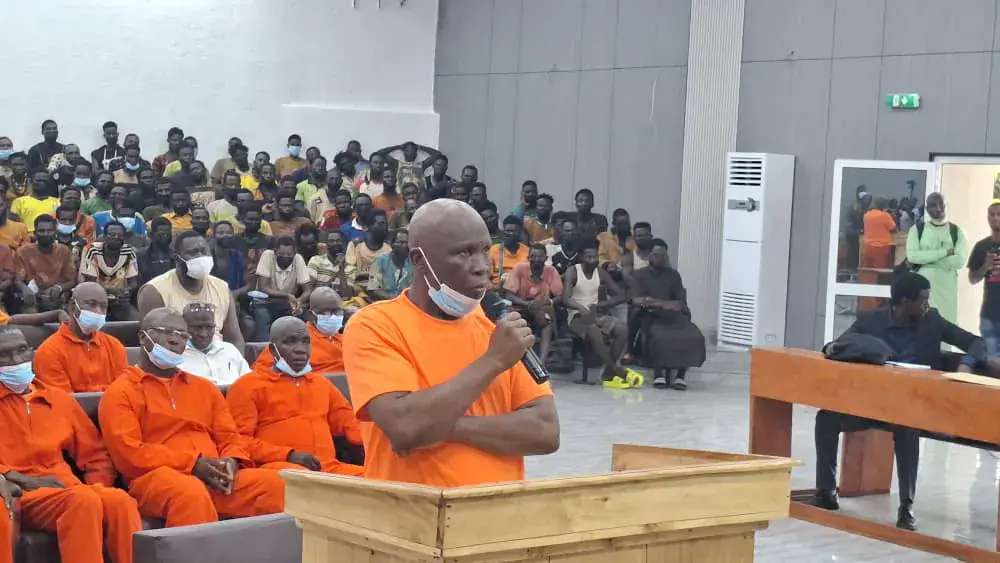
A Guinean court has convicted 22 former territorial administrators and 202 illegal miners on charges of environmental degradation, corruption, and related offenses. The verdict was delivered on November 16, 2026, by the Court of Repression of Economic and Financial Infractions (CRIEF). The defendants were found guilty of complicity in environmental degradation, destruction, and water pollution. The court handed down prison sentences and hefty fines to the convicts.
The 22 former administrators, including Richard Yarabou, Moussa Diakité, and Roger Lama, were sentenced to two years in prison and fined 10 million Guinean francs each. They were convicted of complicity in environmental degradation, destruction, and water pollution. However, they were acquitted of charges of public corruption, illicit enrichment, and money laundering. The administrators were found to have played a role in the illegal mining activities.
The 202 illegal miners, including several foreign nationals, received harsher sentences. They were convicted of corruption, illicit enrichment, and environmental degradation. The court sentenced them to three years in prison and ordered them to pay a joint fine of 10 billion Guinean francs. Additionally, foreign nationals involved in the case were banned from entering Guinea for 10 years.
The court's decision was based on evidence presented during the trial. The case was widely followed in Guinea due to the large number of defendants and the severity of the charges. The CRIEF court was established to combat economic and financial crimes in the country. The court's verdict demonstrates its commitment to holding individuals accountable for environmental degradation and corruption.
The case highlights the issue of illegal mining in Guinea, which has caused significant environmental damage. The country's mining sector is a major contributor to its economy, but illegal mining activities have been a longstanding problem. The government's efforts to crack down on these activities have been welcomed by environmental groups and local communities.
The convicts will be required to pay the costs of the trial. The court's decision is a significant step towards holding individuals accountable for environmental degradation and corruption in Guinea. The case is expected to serve as a deterrent to others involved in similar activities. The Guinean government has reiterated its commitment to fighting corruption and protecting the environment.
The verdict was announced by the CRIEF court on November 16, 2026. The case will likely have far-reaching implications for the mining sector in Guinea. The court's decision demonstrates its commitment to upholding the law and protecting the environment.
Key points
- 22 former Guinean administrators and 202 illegal miners were convicted for environmental degradation and corruption.
- The convicts were sentenced to prison terms and hefty fines.
- The case highlights the issue of illegal mining in Guinea and the government's efforts to combat it.