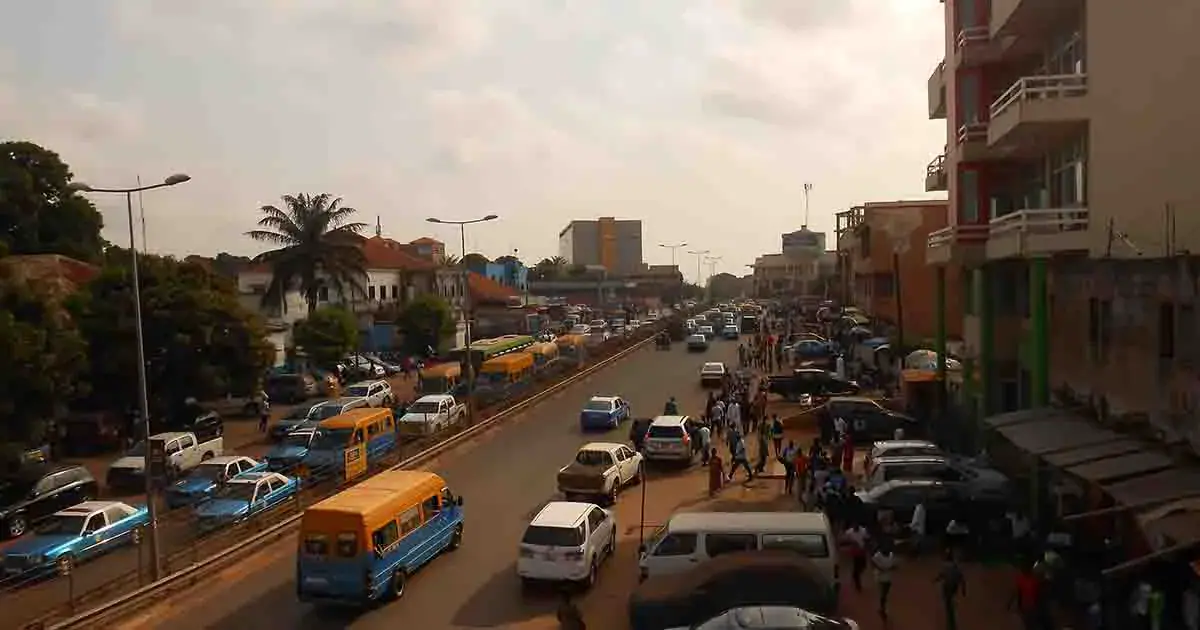
Guiné-Bissau, officially the Republic of Guinea-Bissau, is a country located on the western coast of Africa, covering an area of 36,125 square kilometers and having a population of 2,191,202 inhabitants, according to the 2026 preliminary census results. The capital city is Bissau, and the country is divided into eight administrative regions and the Autonomous Sector of Bissau. The country also includes the Bijagós Archipelago, comprising numerous islands and islets.
The country's independence was proclaimed on September 24, 1973, and recognized by Portugal on September 10, 1974, following a national liberation struggle led by the African Party for the Independence of Guinea and Cape Verde (PAIGC). The economy primarily relies on agriculture, trade, fishing, and services, with cashew nuts being a major export product. Despite its potential, the country faces significant challenges, including poverty, political instability, and vulnerability to climate change.
Guiné-Bissau's geographical location makes it an important player in West African regional dynamics. The country shares borders with Senegal and the Republic of Guinea. Its coastal and marine ecosystems, particularly in the Bijagós Archipelago, have been recognized for their biodiversity and were inscribed as a UNESCO World Heritage Site in 2025. This recognition highlights the country's natural heritage and its importance for global conservation efforts.
The country's administrative division includes eight regions and the Autonomous Sector of Bissau, with Portuguese being the official language. However, the Guinean Creole is widely used by the population for communication. The official currency is the West African CFA franc (XOF). The current political situation is characterized by a transition under military leadership, with General Horta Inta-a as the President of Transition and Ilídio Vieira Té as the Prime Minister.
Economically, Guiné-Bissau has a nominal GDP of $2.53 billion and a per capita GDP of $1,123.80 as of 2025, according to the World Bank. The country's Human Development Index (HDI) was 0.514 in 2023, indicating significant development challenges. The life expectancy at birth is 64 years, reflecting the country's ongoing efforts to improve healthcare and living standards.
The country's infrastructure and communication networks are developing, with a country code +245 and a top-level domain .gw. The time zone is UTC+0, which facilitates coordination with international partners. Despite these developments, Guiné-Bissau continues to face substantial hurdles in achieving sustainable economic growth and improving the quality of life for its citizens.
Moving forward, addressing the challenges of poverty, political instability, and economic diversification will be crucial for Guiné-Bissau's sustainable development. The international community, including organizations like the United Nations Development Programme (UNDP) and the World Bank, plays a significant role in supporting the country's efforts to overcome these obstacles and achieve its development goals.
Key points
- The country's economy primarily relies on agriculture, trade, fishing, and services.
- Guiné-Bissau faces significant challenges, including poverty, political instability, and vulnerability to climate change.
- The Bijagós Archipelago's ecosystems were recognized as a UNESCO World Heritage Site in 2025.
Reporting sources
- Guiné-Bissau: história, população, economia, geografia e cultura · Hold On Angola