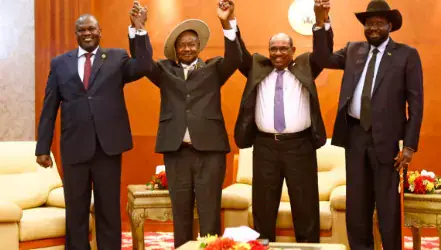
The guarantors of South Sudan's 2018 peace agreement, including the Intergovernmental Authority on Development (IGAD), the African Union (AU), the United Nations (UN), and the Troika, have been urged to intervene decisively to halt premature polls and compel the government to return to genuine implementation of the agreement. The country's political atmosphere is characterized by deep polarization, widespread public frustration, and a sharp rejection of incumbent President Salva Kiir's leadership.
The 2018 Revitalized Peace Agreement did not envision general elections as a stand-alone event, but rather as the last phase of the transitional process, setting the foundation for post-conflict reconstruction in South Sudan. The agreement sought to establish a unified security force, a permanent constitution, a functioning electoral system, and a transitional justice system. However, the implementation of the agreement has been slow, and the parties adopted a roadmap that extended the transitional period and moved the general elections to December 2026.
The debate changed in September 2026 when the electoral framework was amended to remove the completion of the permanent constitution and national census as prerequisites for conducting national elections. This may remove legal and practical obstacles to conducting the election, but it also changes the sequencing envisioned by the peace agreement. The reconfiguration of the institutions through which the R-ARCSS power-sharing agreement had been operated has significantly changed the political context.
The growing uncertainty surrounding the general election stems from the weak implementation of the R-ARCSS, which set clear guidelines to be followed before any general elections can take place. Failure to do so will increase the danger as fighting continues in many parts of the country, and the rule of law and justice mechanisms envisioned by R-ARCSS remain incomplete. The arrest and trial of former Vice President Dr. Riek Machar, who is also the leader of the Sudan People's Liberation Movement-in-Opposition (SPLM-IO), is a serious concern.
The non-signatory parties President Salva Kiir has mobilized to 'challenge' him in the sham elections are just rubber stamps and insignificant. They provide a facade of multiparty democracy while lacking independent constituencies and just want to validate the elections and give Kiir legitimacy as an elected president. South Sudan's one-party-handpicked so-called "National Election Commission" announced the postponement of the single-party elections from December 2026 to February 2027.
The delay comes as a result of the electoral commission's desire for more time to distribute registration materials and conduct civic education. Those activities will be carried out amid growing violence and political tensions across the country. If South Sudan continues to be led by Kiir, the country's political stability and desirable economic development will only deteriorate. Furthermore, ethnic divisions, corruption, and underfunded public services will destabilize social stability.
South Sudan stands at a dangerous crossroads at the moment. Moving forward with general elections before fulfilling the foundational pillars of the 2018 revitalized peace agreement threatens to plunge the country back into full-scale civil war. The signatories to the Revitalized Peace Agreement must be reminded that South Sudan is facing severe political tensions, shrinking civic space, and heightened conflict as it approaches national elections.
Key points
- The guarantors of the 2018 peace agreement must intervene to halt premature elections in South Sudan.
- The implementation of the 2018 peace agreement has been slow, and the country is not ready for general elections.
- The elections should be postponed to allow for the completion of critical tasks, including the establishment of a unified security force, a permanent constitution, and a functioning electoral system.