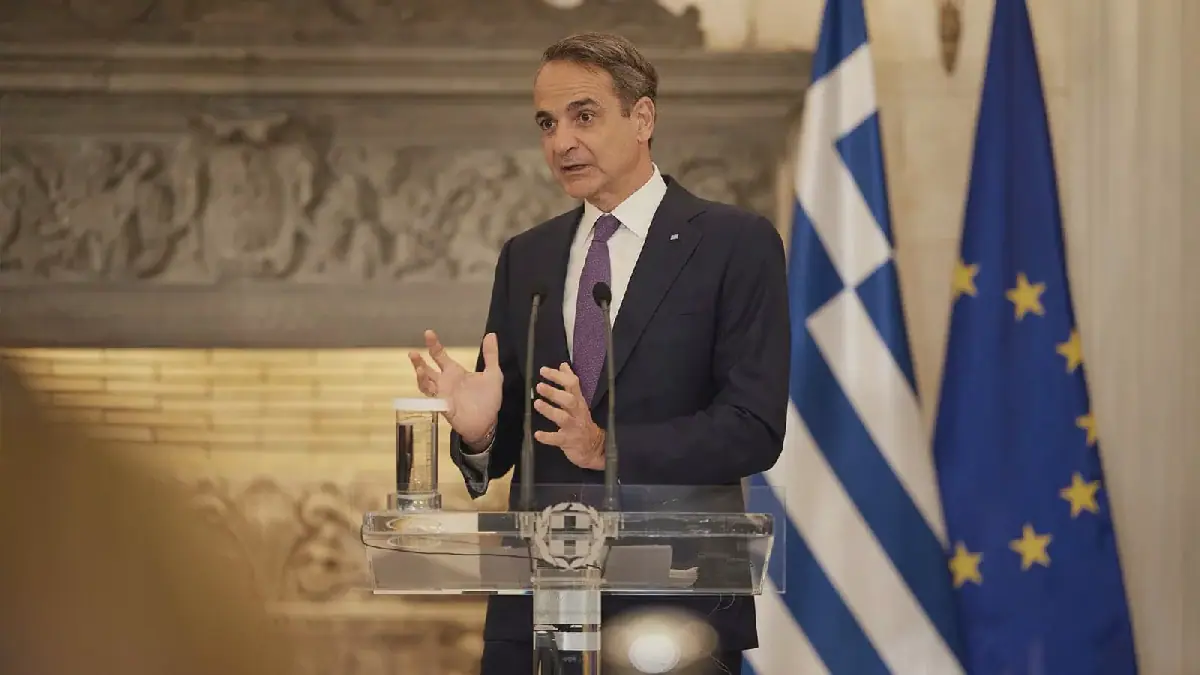
Greek Prime Minister Kyriakos Mitsotakis addressed the UN Security Council, expressing strong objections to the maritime agreement between Libya and Turkey signed in 2019. He described the agreement as unlawful and contrary to the fundamental principles of international maritime law. Mitsotakis used a map to illustrate Greece's stance on the demarcation, emphasizing that the agreement created maritime boundaries between Turkey and Libya despite their non-adjacent coastlines.
Mitsotakis argued that the agreement disregarded the existence of Greek islands between the two countries' coastlines, effectively ignoring them. He stressed that geography cannot be altered by drawing arbitrary maritime lines. According to Mitsotakis, international law grants islands rights to maritime areas, including the continental shelf and exclusive economic zone, as per the UN Convention on the Law of the Sea.
The Greek Prime Minister emphasized that any bilateral agreement cannot deprive a third country of its sovereign rights or override international law. He asserted that the Libya-Turkey maritime agreement violates these principles and has no legal effect on Greece's sovereign rights. Mitsotakis also noted that the recent ratification of the agreement by the Libyan House of Representatives does not legitimize what he described as an unlawful agreement.
Mitsotakis's statements reflect Greece's ongoing objections to the Libya-Turkey maritime agreement, which Athens believes undermines its maritime rights in the Eastern Mediterranean. Greece has consistently maintained that it will not accept arrangements that compromise its maritime zones. The disagreement has been a point of contention between Greece, Turkey, and Libya for some time.
The maritime agreement between Libya and Turkey has significant implications for the region, particularly in terms of natural gas exploration and exploitation. Greece, Cyprus, and Turkey have been involved in a longstanding dispute over maritime boundaries and natural gas reserves in the Eastern Mediterranean. The issue remains a major point of tension in the region.
In his address to the Security Council, Mitsotakis reiterated Greece's commitment to resolving disputes through international law and dialogue. He emphasized that Greece will continue to assert its rights and interests in the maritime domain. The Greek Prime Minister's statements reflect a broader effort to garner international support for Greece's position on the maritime agreement.
The Libya-Turkey maritime agreement has sparked concerns among various regional and international actors. The agreement's implications for regional stability and security are being closely watched. Key points include:
Key points
- The agreement's impact on regional natural gas exploration and exploitation
- Greece's concerns over the agreement's implications for its maritime rights
- The ongoing dispute between Greece, Turkey, and Libya over maritime boundaries