The Kenyan government has moved to address the significant annual loss of over Sh11 billion in the water sector. This loss is attributed to physical leaks or spillage, illegal connections, faulty or unmetered connections, and billing inefficiencies. According to Cabinet Secretary for Water, Sanitation and Irrigation Eng. Eric Muriithi Mugaa, about 242 million cubic meters of water out of 504 million cubic meters produced annually is lost. This non-revenue water accounts for 44 to 48 percent of the total water produced.
To combat this issue, CS Mugaa has directed all water agencies to take immediate action to stem the losses. The government has established a specialized Water Police Unit to help water agencies and service providers address illegal connections and protect public water infrastructure. The police officers, deployed at the headquarters of water agencies, are expected to support efforts to curb water theft and strengthen enforcement. Lake Victoria South Water Works Development Agency (LVSWWDA) has been allocated 10 officers under this initiative.
The government is pursuing policy and institutional reforms to bridge financing gaps, improve accountability, and increase access to safe water. CS Mugaa noted that some infrastructure components installed using taxpayers' money get vandalized shortly after construction, with stolen materials finding their way onto the black market. He called for stronger enforcement against vandalism, warning that destruction and theft of water infrastructure undermine public investments and increase maintenance costs.
Kenya is classified as a water-scarce country, with renewable freshwater supplies dropping below 1,000 cubic meters per capita every year. Total available renewable water resources are estimated at roughly 22.5 billion cubic meters per year. About 19 to 20 million Kenyans lack access to basic drinking water, and roughly 33 to 36 million lack access to basic sanitation facilities. The CS urged water agencies to consider practical infrastructure designs that would make installations more visible, accessible for maintenance, and less vulnerable to vandalism.
CS Mugaa challenged water service providers to move beyond celebrating marginal improvements and work towards significantly reducing water losses. He questioned the justification for accepting 25 percent as an industry benchmark, citing international examples such as Japan, where non-revenue water levels are reportedly below seven percent. The government has introduced key reforms through the 2024 amendment to the Water Act, which expanded the mandate of Water Works Development Agencies to include bulk water service provision.
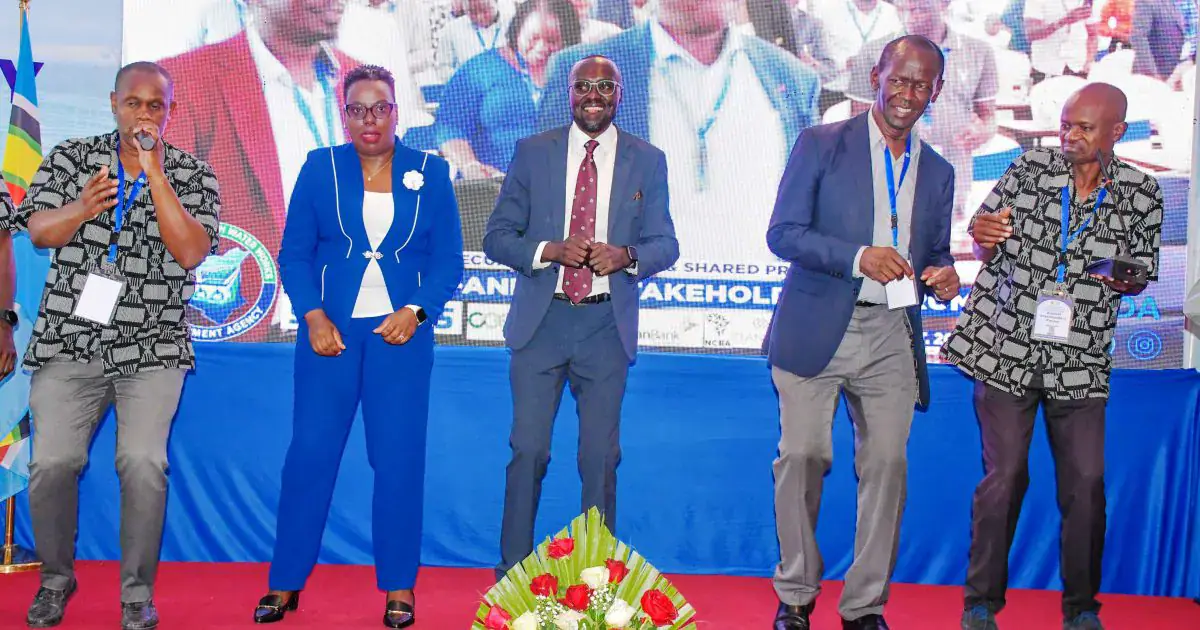
During the Lake Victoria South Water Works Development Agency's Annual Stakeholders meeting in Kisumu, CS Mugaa highlighted several infrastructure development programs expected to benefit the Lake Victoria South region. These initiatives include the Kenya Towns Sustainable Water Supply and Sanitation Programme and the National Urban Water and Sanitation Programme. The region is expected to benefit from new projects, rehabilitation works, and last-mile water connectivity.
LVSWWDA received a bulk water service provision license from the Water Services Regulatory Board (WASREB), allowing it to take up additional responsibilities in bulk water supply. The CS emphasized that achieving sustainable water security requires collective responsibility involving the national government, county governments, water agencies, service providers, and the private sector. LVSWWDA Chief Executive Officer, Jacklyn Kemunto, said the stakeholders' forum was convened to evaluate achievements made since the launch of the 2023–2027 Strategic Plan.
Key points
- The Kenyan government has established a specialized Water Police Unit to address illegal connections and protect public water infrastructure.
- Kenya is classified as a water-scarce country, with about 19 to 20 million Kenyans lacking access to basic drinking water.
- The government has introduced reforms through the 2024 amendment to the Water Act to expand the mandate of Water Works Development Agencies.