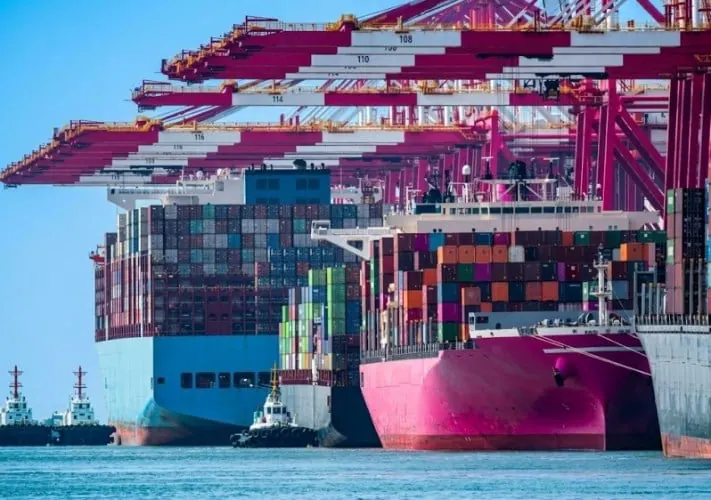
A recent report by Sea-Intelligence, a leading shipping research firm, has highlighted a significant decline in global shipping reliability. The report, which covers data up to August 2026, notes that the global reliability of shipping schedules has dropped to 49.9%. This marks the lowest level since September 2022, with a 5.9 percentage point decrease from the previous month. The decline is attributed to severe congestion in Asian ports.
The report also reveals that the average delay for late-arriving ships has increased to 6.81 days, the highest level since March 2022. On a yearly basis, this represents an increase of 1.92 days. The data suggests that the shipping industry is facing significant challenges in maintaining reliable schedules. Egypt, being a key player in global shipping, is likely to be impacted by these trends.
Maersk, a major shipping company, has emerged as the most reliable carrier, with a reliability rate of 67.3% in August 2026. Hapag-Lloyd follows closely, with a rate of 61.5%. MSC and CMA CGM also feature prominently, with rates of 55.2% and 50.6%, respectively. However, Wan Hai had the lowest reliability rate at 23.2%. These rankings highlight the varying levels of performance among major shipping companies.
Notably, none of the 13 major shipping companies recorded an improvement in reliability on a monthly basis in August 2026. ONE experienced the smallest decline, at 3.5 percentage points, while PIL saw the largest drop, at 10.1 percentage points. On a yearly basis, no company showed an improvement in schedule accuracy. Maersk had the smallest annual decline, at 8.9 percentage points, while PIL experienced the largest drop, at 31.1 percentage points.
The report also analyzed the performance of shipping alliances. The Gemini alliance topped the list, with a reliability rate of 77.8% in August 2026. MSC followed, with a rate of 70.1%, while Ocean Alliance had a rate of 48.3%. Premier Alliance had the lowest rate, at 43.2%. These findings suggest that alliances are playing an increasingly important role in the shipping industry.
The decline in shipping reliability has significant implications for global trade. As ports continue to experience congestion, shipping companies are facing mounting challenges in maintaining reliable schedules. The situation is likely to have a ripple effect throughout the global economy, impacting businesses and consumers alike. Egypt, as a major hub for international trade, will be closely watching these developments.
In conclusion, the Sea-Intelligence report highlights the pressing issues facing the global shipping industry. With reliability rates at a 4-year low, shipping companies and alliances must adapt to the changing landscape. As the industry continues to evolve, stakeholders will be monitoring developments closely to mitigate the impact of congestion and unreliability on global trade.
Key points
- Global shipping reliability has dropped to 49.9%, the lowest level since September 2022.
- Maersk emerged as the most reliable carrier, with a rate of 67.3% in August 2026.
- None of the 13 major shipping companies recorded an improvement in reliability on a monthly or yearly basis in August 2026.