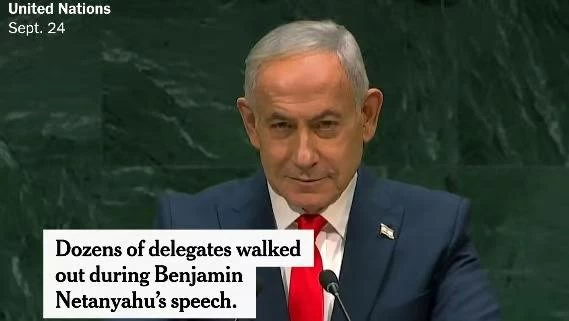
Egyptian and global media outlets provided extensive coverage of Israeli Prime Minister Benjamin Netanyahu's speech at the United Nations General Assembly in New York. The speech was marked by the withdrawal of dozens of diplomats and a nearly empty hall. Media reports characterized Netanyahu's speech as an attack on his critics and a bid to rally support among Israeli voters ahead of the 26th Knesset elections.
According to reports from news agencies such as AP and AFP, Netanyahu's speech was seen as an attempt to address Israeli voters rather than the international community. The speech was broadcast during prime time in Israel, 32 days before the elections. Media outlets noted that Netanyahu's approval ratings have been declining in recent polls, and his speech was an effort to regain support by criticizing international criticism and claiming to be the only leader capable of addressing threats to Israel.
The Associated Press described Netanyahu's speech as a "sharp attack on critics of his policies," noting that it resembled a campaign speech. The agency also highlighted the consequences of the "bagger incident," which resulted in over 3,000 injuries and 12 fatalities, including two children. AP reported that Netanyahu's government is dominated by settlers and their allies, citing over 1,600 documented settler attacks this year.
The French Press Agency, AFP, reported that Netanyahu, who leads the most right-wing government in Israeli history, has led the country into multiple conflicts in Gaza, Lebanon, Syria, and Iran, and has accelerated settlement expansion in the occupied West Bank. AFP also noted that Netanyahu's visit was marked by a lack of meetings with senior US officials and a confrontation with New York City Mayor Zahran Mمدani.
US media outlets also covered Netanyahu's speech extensively. The New York Times reported that Netanyahu directly attacked Mayor Mمدani, attempting to convince Israeli voters that international criticism is unjustified. The Times noted that despite Netanyahu's warnings about Iran's nuclear program, he has failed to secure US support for military action. The Wall Street Journal described Netanyahu's speech as demonstrating his deep isolation, with even his usual supporters in the US turning against him.
The Washington Post reported that Netanyahu's speech was an attempt to bolster his chances of re-election, amid a challenging domestic political landscape. The Post noted that Netanyahu's relations with US President Trump have cooled, and there are disagreements over dealing with Iran. NBC News highlighted the mass withdrawal of diplomats during Netanyahu's speech and noted that his main domestic challenge comes from the right wing, which accuses him of insufficiently addressing security concerns.
European and British media outlets also covered Netanyahu's speech. The French daily Le Monde reported on Netanyahu's direct attack on French President Emmanuel Macron, while the Italian newspaper Corriere della Sera focused on the empty hall during Netanyahu's speech. The UK's Daily Mail highlighted Netanyahu's rejection of "genocide" accusations and noted that most seats were empty when he began speaking.
Key points
- Netanyahu's speech at the UN was seen as an attempt to rally support among Israeli voters ahead of elections.
- The speech was marked by the withdrawal of dozens of diplomats and a nearly empty hall.
- Media outlets characterized Netanyahu's speech as an attack on his critics and a bid to address his declining approval ratings.