Antimicrobial resistance (AMR) is an increasingly serious threat to human health, food security, agriculture, and the environment. Global health experts stress that tackling the growing threat requires coordinated action across human, animal, and environmental health systems. The Director of the Antimicrobial Resistance Department at the World Health Organisation (WHO), Dr Jean-Pierre Nyemazi, said bacterial antimicrobial resistance was associated with more than 4.7 million deaths globally in 2021.
The misuse and overuse of antimicrobial medicines, weak infection prevention and control measures, poor water and sanitation systems, and environmental contamination are accelerating the spread of drug-resistant infections. Dr Nyemazi expressed concern that despite global political commitments, implementation remained weak in many countries due to inadequate financing, fragmented coordination, poor surveillance systems, and inappropriate use of antimicrobials.
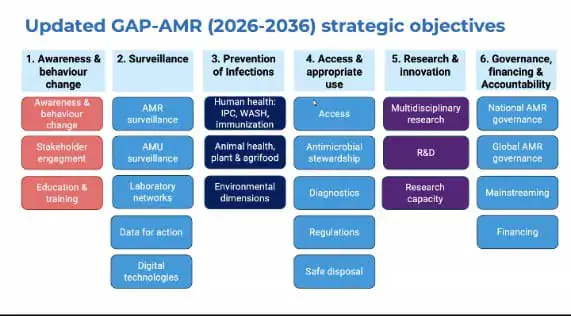
The updated Global Action Plan on AMR for 2026–2036 provides a renewed framework for strengthening national responses, improving surveillance, and ensuring responsible antimicrobial use. World leaders, at the 2024 United Nations General Assembly High-Level Meeting on AMR, committed to reducing deaths associated with bacterial AMR by 10 per cent by 2030, using the 2019 baseline of 4.95 million deaths.
The Deputy Chief Veterinarian and Chief of the One Health and Disease Control Branch of the Food and Agriculture Organisation (FAO), Dr Junxia Song, warned that global antibiotic use in livestock could increase by nearly 30 per cent by 2040 if urgent preventive measures were not adopted. Improved animal health services and better farm management practices could reduce antibiotic use by as much as 57 per cent.
The Antimicrobial Resistance Coordinator at the United Nations Environment Programme (UNEP), Aitziber Echeverria, cautioned that efforts to contain AMR would remain incomplete without addressing pollution and the release of antimicrobial residues and resistant microorganisms into the environment. She identified pharmaceutical manufacturing, agriculture and food production, healthcare systems, and municipal waste and wastewater management as critical areas requiring urgent intervention.
Experts stress that addressing AMR requires a multisectoral approach, including stronger primary healthcare and community-based interventions to promote infection prevention, early diagnosis, and appropriate treatment. The WHO Senior Technical Officer and Lead of Multisectoral Coordination, Dr Kefas Samson, called for greater emphasis on measurable outcomes, coordinated multisectoral action, improved laboratory capacity, equitable access to quality-assured medicines, and sustainable financing.
Key points
- The World Health Organisation reports that bacterial antimicrobial resistance was associated with more than 4.7 million deaths globally in 2021.
- The Fifth Global High-Level Ministerial Conference on AMR will be held in Abuja, Nigeria, from December 6 to 8, 2026.
- Global antibiotic use in livestock could increase by nearly 30 per cent by 2040 if urgent preventive measures are not adopted.