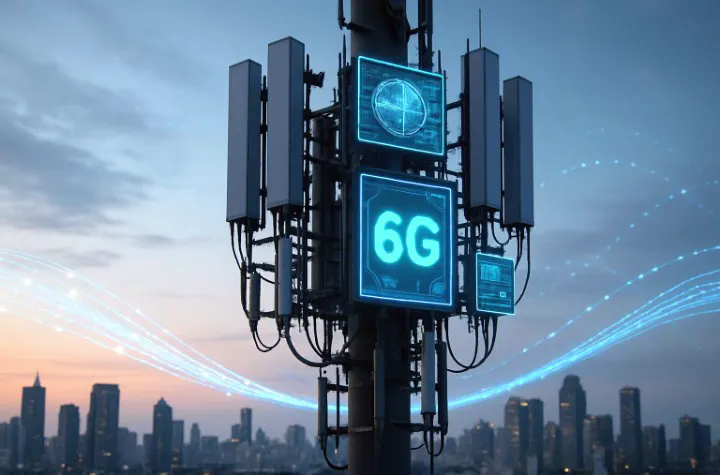
The next generation of mobile technology, 6G, is expected to move from initial commercial deployment to large-scale adoption in the coming years. According to GSMA Intelligence, the research arm of the GSMA, global 6G connections are projected to reach 2.4 billion by 2035, representing about 23% of worldwide mobile connections. This projection indicates a significant increase in the adoption of 6G technology.
The transition to 6G is expected to begin gradually, with approximately 50 million 6G connections expected by the end of 2030. This number is equivalent to about 0.5% of the global mobile connections base. By 2031, 6G connections are projected to rise to 275 million, and by 2032, they are expected to reach nearly 740 million. The growth in 6G connections is expected to accelerate sharply after the initial commercial launch phase.
The adoption of 6G is expected to vary across regions. GSMA Intelligence forecasts that China will account for more than half of global 6G connections by 2035. North America and East Asia are also expected to record high adoption levels. In contrast, 6G adoption is expected to remain below 10% in several emerging-market regions by 2035. This disparity in adoption rates is likely to be due to the fact that many emerging markets will still be completing the transition from 4G to 5G.
Despite the growth of 6G, existing mobile technologies are not expected to be immediately displaced. GSMA forecasts that 5G will still account for about 60% of global mobile connections by 2035, compared with 23% for 6G and 17% for 4G. This indicates that 5G will continue to be a dominant technology in the near future. The coexistence of 6G with a larger 5G base is expected to be a key feature of the mobile technology landscape.
The emergence of 6G is expected to increase pressure on network infrastructure due to the growth in mobile data traffic. GSMA Intelligence forecasts that global mobile network traffic will rise from about 204 exabytes (EB) per month in 2025 to 846EB per month by 2035. This represents a more than fourfold increase and annual growth of roughly 15%. The growth in mobile data traffic will be driven by various factors, including artificial intelligence, extended reality (XR), connected devices, and video.
The changing traffic pattern is expected to increase demand for uplink capacity, lower latency, network reliability, and greater automation. According to GSMA's Vision 2040 analysis, the increasing demand for mobile data traffic will require significant investments in network infrastructure. The organisation's forecasts indicate that the growth in mobile data traffic will have a major impact on the development of mobile technologies.
According to Matthew Iji, Head of Data Modelling and Forecasting at GSMA Intelligence, the 2.4 billion connections projected for 2035 should be viewed as a milestone rather than the end point of 6G development. He noted that 6G will coexist with a much larger 5G base, while 4G will continue to serve significant portions of the market. The growth of 6G is expected to be a gradual process, with significant investments required in network infrastructure to support the increasing demand for mobile data traffic.
Key points
- Global 6G connections are projected to reach 2.4 billion by 2035.
- 5G is expected to account for 60% of global mobile connections by 2035.
- China is expected to account for more than half of global 6G connections by 2035.