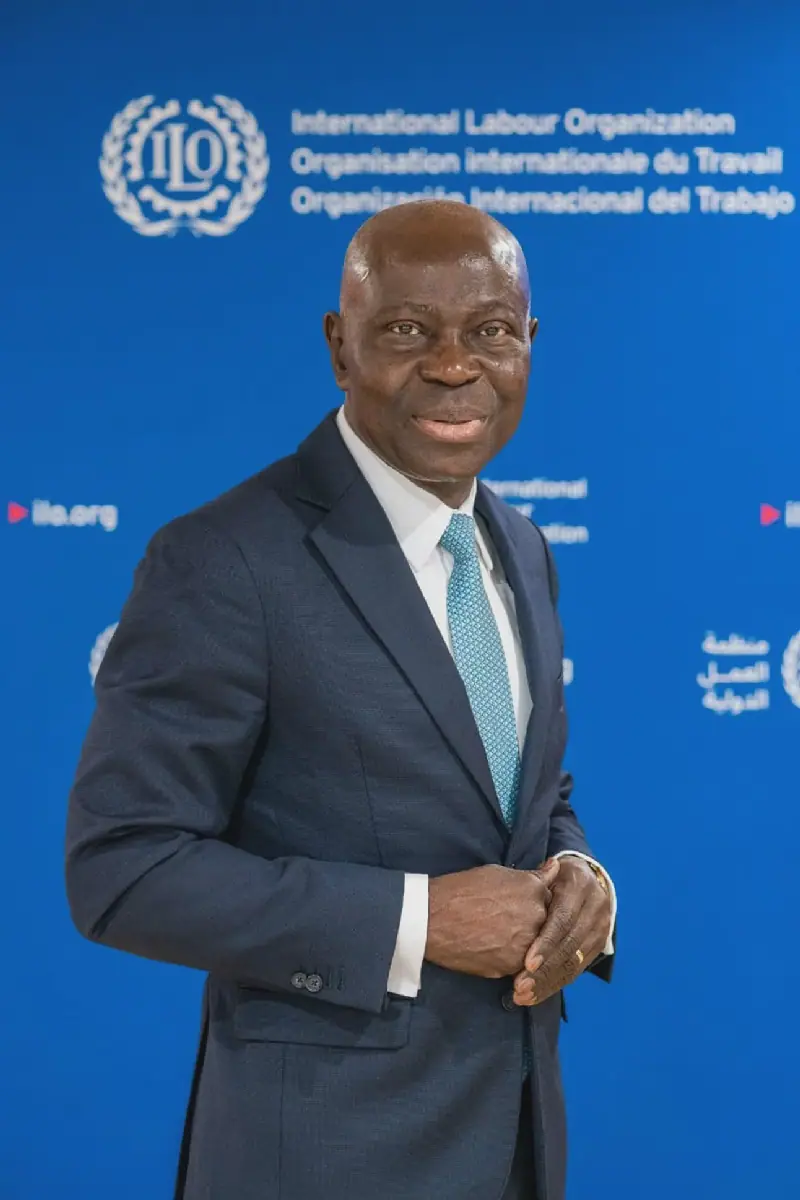
Gilbert Houngbo, the current Director-General of the International Labour Organization (ILO), has been re-elected for a second five-year term. He secured 51 votes with five abstentions, and his second term is set to begin on October 1, 2027. Houngbo, a Togolese national, is the 11th Director-General of the ILO and the first African to hold this position. His re-election was announced on November 16, 2026, in Geneva, Switzerland, during the 358th session of the ILO's Governing Body.
The re-election process involved a secret ballot, with two other candidates initially in the running: Yolanda Díaz Pérez, the Spanish Deputy Prime Minister, and Javier González-Olaechea Franco, a former Peruvian Minister. However, both withdrew their candidacies before the vote. The electoral process began on September 23, 2026, with a public presentation of the candidates' visions for the ILO's future, followed by closed-door hearings on November 9. The Governing Body ultimately made the decision in favor of Houngbo.
Houngbo's re-election reflects the international support he enjoys from the three main constituents of the ILO: governments, employers, and workers. The International Confederation of Trade Unions (ICSI) had announced its support for his candidacy on October 30, 2026, despite some differences within the European trade union movement. The African Union also played a significant role in his campaign, mobilizing in favor of the Togolese candidate. The organization's continental body hailed his re-election as a collective success.
In his speech after re-election, Houngbo emphasized his commitment to serving all ILO constituents without distinction. He vowed to be the Director-General of each and every one of them, promising to serve the organization without exclusion, preference, or distinction. He also assured that he was prepared to make difficult decisions when the organization's interest required it. Houngbo highlighted the fundamental mission of the ILO, created in 1919 and becoming a specialized agency of the United Nations in 1946.
The ILO has undergone significant developments during Houngbo's first term, including strengthened action on international labor standards and the launch of the Global Coalition for Social Justice. The organization has also undertaken institutional reforms aimed at improving its efficiency and effectiveness while intensifying its work on transformations in the world of work, particularly in the digital economy. Houngbo stressed the importance of tripartism, which is unique to the ILO and relies on the participation of governments, employers, and workers in policy-making and international labor standards.
However, the ILO faces significant challenges, including a budget deficit of $362 million, largely due to unpaid contributions and arrears from its member states. This situation requires a transformation of its operations and a reflection on the long-term financial viability of its activities. Measures to reduce the budget and cut posts have raised concerns among staff and worker representatives. In the week leading up to the vote, ILO employees and former employer representatives demonstrated in Geneva against approved budget cuts and post reductions.
Looking ahead to his second term, Houngbo aims to strengthen the ILO's normative and supervisory functions, consolidate its presence on the ground, and pursue operational reforms. The issue of artificial intelligence is also high on his agenda, as he considers it a major challenge facing the world of work. While AI offers considerable opportunities, it also raises fundamental questions about employment, skills, and the organization of work. Houngbo will need to navigate these complex issues while maintaining the support of the ILO's diverse constituents.
Key points
- Gilbert Houngbo was re-elected as Director-General of the ILO with 51 votes and five abstentions.
- His second term will focus on strengthening the organization's normative functions, consolidating its presence on the ground, and addressing the challenges posed by artificial intelligence.
- The ILO faces a significant budget deficit of $362 million, which will require careful management and reform.