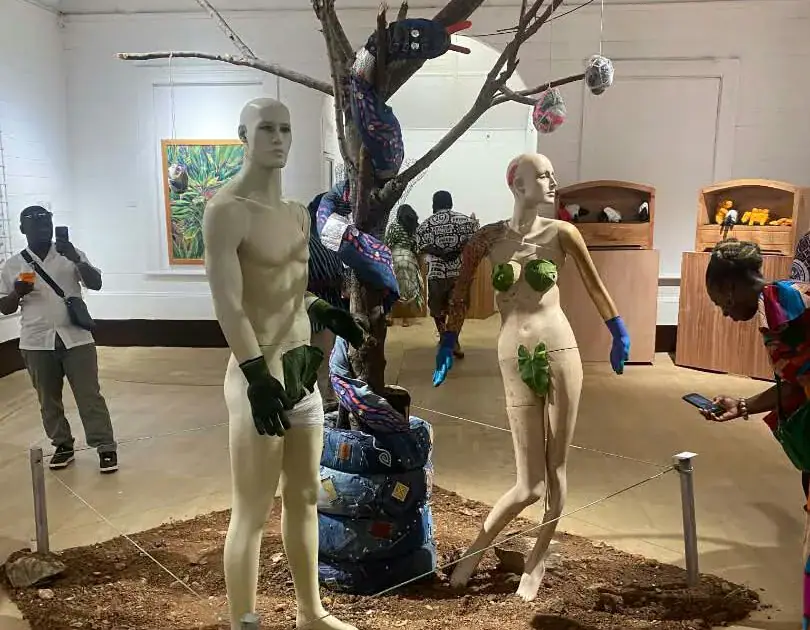
Ghanaian fashion curator Beatrice "Bee" Arthur has created an art installation at the Accra Art Centre to highlight the environmental impact of the global fashion industry. The installation, titled JEAN-ESIS: Chapter One, features discarded clothing and other waste materials arranged to depict the environmental consequences of clothing production and consumption. This work is part of the BEYOND CREATION: Humanity, Nature and Spirituality, a Universal Message exhibition, organised in collaboration with the Embassy of Italy.
The exhibition, which opened on October 4, features 40 artists, about 90 per cent of whom are Ghanaian, and runs until November 4, 2026. Arthur draws much of her material from Kantamanto Market in Accra, a major destination for second-hand clothing imported from Europe, North America and Asia. The clothes, commonly referred to in Ghana as obroni wawu, meaning "dead white man's clothes", are sold in bales, but a significant proportion are discarded because they cannot be resold or reused.
According to estimates by The Or Foundation, a non-profit organisation working in Kantamanto, about 15 million garments arrive at the market every week, with approximately 40 per cent becoming waste. Much of this ends up in dumpsites, drains and on beaches. Arthur uses discarded denim from the market to examine how the global demand for inexpensive clothing creates environmental challenges for countries that receive second-hand garments.
The installation features old denim, used tyres, rubber gloves, dead tree branches and mannequins. The branches and dead trees came from a cemetery, while used tyres were sourced from vulcanisers in her neighbourhood. Textile offcuts and rubber gloves were also incorporated into the work, which took four weeks to complete. The installation also features mannequins, some of which are about 20 years old, representing garment workers in denim factories across Asia.
A central feature of the installation is a hand-stitched and hand-painted serpent, representing wisdom, fertility, regeneration and hope. Through these elements, the artist explores the relationship between clothing consumption, environmental degradation and the human decisions that contribute to waste. The work also draws attention to the mixed impact of Ghana's second-hand clothing trade, supporting thousands of traders and tailors while leaving the country dealing with large quantities of discarded clothing.
The broader exhibition is curated by Nuna Adisenu-Doe and Andrea Walter Ghia, bringing together Ghanaian and international artists to explore humanity's relationship with nature and spirituality. The opening ceremony attracted artists, cultural institution representatives and diplomats, including Italy's Ambassador to Ghana and Togo, Laura Ranalli, and Dr Fio Richardson Commey, Special Aide to the Minister for Tourism, Culture and Creative Arts.
Arthur acknowledged the support of Wakefield Wisdom Ackuaku, Acting Executive Director of the National Commission on Culture, and Eric Ohene-Larbi, Greater Accra Regional Director of the Centre for National Culture, in facilitating the collaboration with the Italian Embassy. The JEAN-ESIS installation serves as a powerful reminder of the environmental consequences of the global fashion industry and the need for sustainable practices.
Key points
- The installation features discarded clothing and other waste materials from Kantamanto Market in Accra.
- The exhibition runs until November 4, 2026, at the Accra Art Centre.
- The installation highlights the environmental impact of the global fashion industry and the need for sustainable practices.