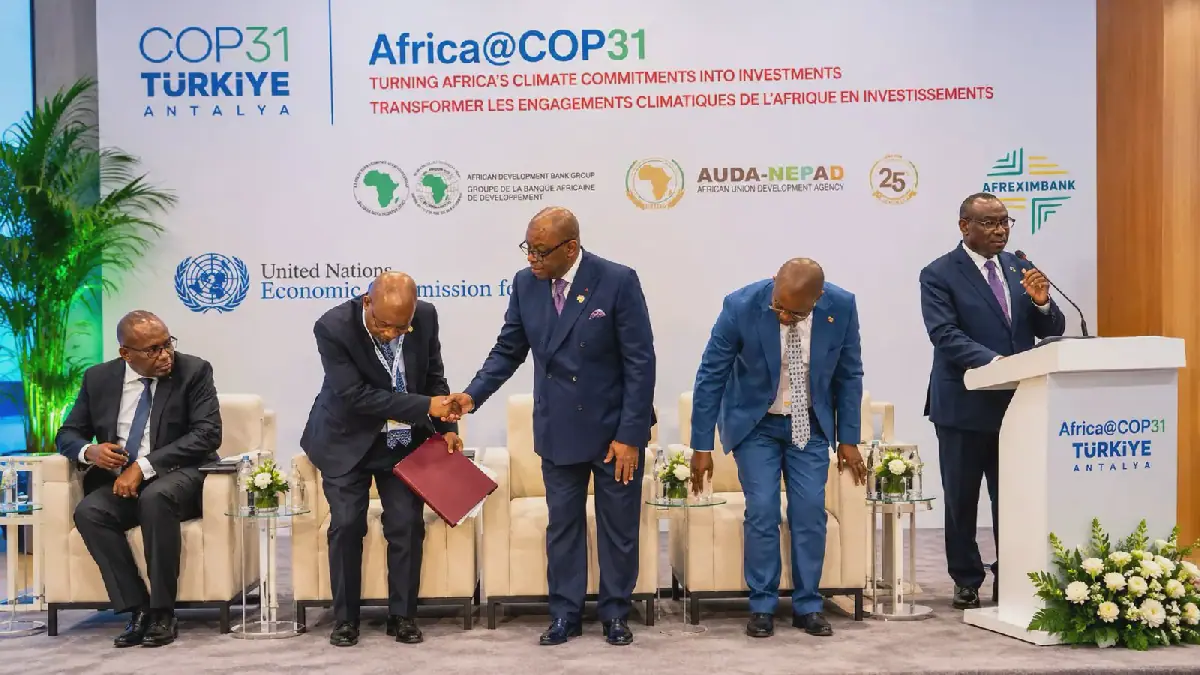
Ghana's Minister of Environment, Science and Technology, Dr. Zanetor Agyeman-Rawlings, has urged developed countries to deliver on their climate finance pledges to Africa, emphasizing that chronic under-delivery of promised funds threatens to undermine the continent's confidence in international climate negotiations. Speaking at the UN Framework Convention on Climate Change meeting in Antalya, Türkiye, Agyeman-Rawlings presented Africa's position at COP31, stressing that climate finance is an obligation under the Paris Agreement and should not be treated as charity or provided mainly through loans.
Africa faces a significant climate finance gap, requiring about $277 billion annually to implement its climate plans by 2030, with current financing covering only about 11% of that amount. The continent also needs approximately $120 billion annually by 2035 to address climate change impacts, with adaptation financing far below that level. Globally, international public funding for adaptation was between $28 billion and $32 billion in 2024, against projected annual needs of $305 billion by 2035. Ghana alone needs more than $20 billion to implement its National Adaptation Plan between 2025 and 2030.
Agyeman-Rawlings emphasized that African countries have submitted credible Nationally Determined Contributions, developed carbon markets, and formulated climate action plans, but lack the financial resources pledged by developed countries to implement those commitments. She stressed that African countries are not seeking to renegotiate existing climate commitments but expect developed countries to honor financing pledges already made. Agyeman-Rawlings called for a clear roadmap to implement the Belém agreement to at least triple adaptation finance for developing countries by 2035.
The minister also urged countries to work towards the broader $1.3 trillion goal outlined in the Baku-to-Belém Roadmap, and warned against double-counting of climate finance and excessive reliance on loans. She emphasized that African countries should not accept new climate obligations without adequate financial, technological, and capacity-building support. Agyeman-Rawlings called on African ministers to defend maintaining the commitment to triple adaptation finance and reject additional obligations without the means to implement them.
On loss and damage, Agyeman-Rawlings noted that the first funding round of the Loss and Damage Fund had about $250 million available against requests estimated at $2 billion to $3 billion, including $1.4 billion from African countries. She also called for recognition of Africa's historical circumstances, including the effects of colonization, in climate discussions. The ministerial meeting considered issues under negotiation at COP31, including climate finance, adaptation, loss and damage, just transition, energy transition, and climate-related trade measures.
Africa holds about 30% of the world's critical mineral reserves, but much of the continent's resources are exported with limited local value addition. Agyeman-Rawlings said Ghana would champion Africa's demands for climate justice beyond Antalya to Addis Ababa ahead of its 2027 African Union Chairmanship. COP32 is scheduled to be hosted by Ethiopia in Addis Ababa in November 2027, and a joint session of African Ministers of Environment and Ministers responsible for Finance, Planning, and Economic Development is expected in Addis Ababa from March 17 to 23, 2027.
The chair of the African Group of Negotiators, Nana Dr. Antwi-Boasiako Amoah, addressed African civil society organizations at COP31, emphasizing that negotiations on climate finance were among the most difficult, particularly on developed countries' obligations under Article 9.1 of the Paris Agreement. The group is pushing for adoption of a work program as part of the agenda to advance Article 9.1 discussions. Agyeman-Rawlings concluded that Africa will not leave Antalya with words alone, emphasizing the need for concrete commitments on climate finance and adaptation.
Key points
- Ghana's Environment Minister Dr. Zanetor Agyeman-Rawlings calls on developed countries to fulfill climate finance pledges to Africa.
- Africa faces a significant climate finance gap, requiring about $277 billion annually to implement its climate plans by 2030.
- Ghana needs more than $20 billion to implement its National Adaptation Plan between 2025 and 2030.
Reporting sources
- Ghana Tells Developed Countries to Deliver Climate Finance as Africa Faces $277bn Gap · West Africa News Agency