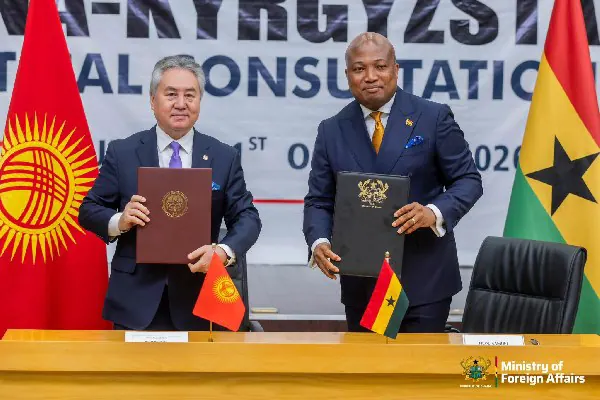
Ghana has signed a package of agreements with Kyrgyzstan, a Central Asian nation with a population of roughly seven million people. The agreements cover gold, farming, and student scholarships, marking a significant step in Foreign Minister Ablakwa's efforts to expand Ghana's diplomatic partnerships beyond its traditional allies. The deals were announced by Ablakwa in a Facebook post on October 3, 2026, following an official visit by Kyrgyzstan's Foreign Minister, Jeenbek Kulubayev.
The agreements signed by Ghana and Kyrgyzstan cover the gold value chain, agribusiness, agricultural mechanization, scholarships, and infrastructure cooperation. According to Ablakwa, these deals aim to build strategic partnerships in these sectors, deepening relations between Accra and Bishkek and opening new avenues for trade and development. Ghana, as Africa's leading gold producer, has significant experience in the gold sector and is interested in formalizing supply and trade links with Kyrgyzstan.
The gold value chain refers to the full chain of activities around gold, from mining and processing to refining and export. Agricultural mechanization involves the use of machinery and equipment to boost farm productivity, an area Ghana has repeatedly flagged as a priority for food security. These sectors are crucial for Ghana's economic development, and the agreements with Kyrgyzstan are expected to enhance cooperation and trade between the two countries.
Beyond the economic agreements, Ghana and Kyrgyzstan have also agreed to coordinate on shared priorities within international organizations. This cooperation is expected to take on added significance from January 2027, when Ghana is due to assume the chairmanship of the African Union, while Kyrgyzstan takes up a seat on the United Nations Security Council. This coordination will enable both countries to work together on key issues affecting international peace and security.
The agreements with Kyrgyzstan follow a broader pattern of diplomatic outreach under Ablakwa's tenure. Ghana recently secured 11 new visa waiver agreements in 2025, and talks are ongoing with Luxembourg and the wider Benelux bloc over a possible visa-free arrangement. These moves point to an effort to diversify Ghana's international partnerships beyond its traditional allies in Europe and North America, reaching into Central Asia as well.
The monetary value of the new agreements, the number of scholarships to be offered to Ghanaian students, and the form of infrastructure cooperation have not been specified. Officials have not given a timeline for when the agreements will be implemented or when the promised trade corridor linking West Africa and Central Asia will become operational. It remains unclear whether Parliament will need to ratify any of the agreements before they take effect.
The implementation of these agreements is expected to strengthen Ghana's diplomatic ties with Kyrgyzstan and enhance cooperation in various sectors. As Ghana assumes the chairmanship of the African Union and Kyrgyzstan takes up a seat on the United Nations Security Council, the two countries are poised to play significant roles in international affairs. The success of these agreements will depend on effective implementation and cooperation between the two nations.
Key points
- The agreements cover the gold value chain, agribusiness, and scholarships.
- Ghana and Kyrgyzstan will coordinate on shared priorities within international organizations.
- The agreements are part of a broader diplomatic push to diversify Ghana's international partnerships.