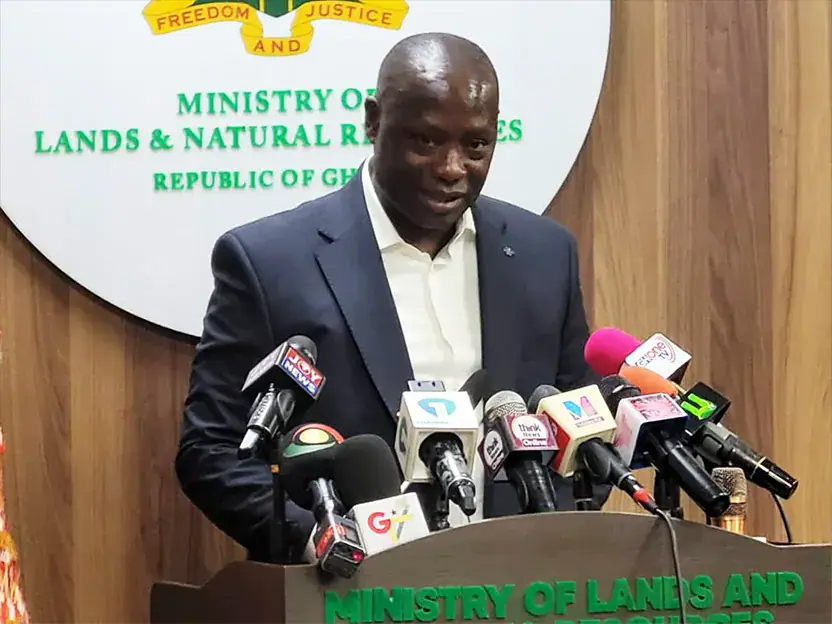
The Ghanaian government has secured commitments to purchase four million tonnes of its newly issued forest carbon credits for an estimated $43 million. This development was announced by Minister for Lands and Natural Resources, Emmanuel Armah-Kofi Buah, at a press engagement in Accra. The credits represent verified emission reductions achieved between 2017 and 2021 through avoided deforestation, reduced forest degradation, and forest landscape restoration.
The approved benefit-sharing arrangement allocates 46% of the benefits to communities, including farmers and traditional authorities, while government institutions will receive 39%. Non-governmental organisations will receive 2%, the private sector 3%, and the Project Management Unit 10% as a fixed management cost. This arrangement was developed through a multi-stakeholder consultative process to ensure that communities contributing to forest protection also benefit from the financial returns.
Ghana has also made available approximately 2.5 million additional credits for future transactions, which could generate another $25 million. However, the country is yet to receive the corresponding payments for the four million credits committed for purchase. The government is working to secure appropriate value from the transactions. The Minister stressed that the country had been working to achieve jurisdictional forest carbon credit issuance under the Architecture for REDD+ Transactions (ART) and its REDD+ Environmental Excellence Standard (TREES).
Ghana is the first African country and the third globally, after Guyana and Costa Rica, to achieve jurisdictional forest carbon credit issuance under the standard. The credits were issued on November 10, 2026, following a thorough verification process. The ART TREES programme assesses forest changes across an entire jurisdiction, taking into account communities, farms, and on-reserve and off-reserve forests. This approach differs from project-based carbon credits.
Buyers, including participants through the LEAF Coalition, have committed to purchasing the four million credits at prices ranging from $10 to $13 per credit. The Minister cited Ghana's experience under the Ghana Cocoa Forest REDD+ Programme, supported by the Forest Carbon Partnership Facility, through which the country received approximately $21.8 million between 2023 and 2024. The programme's benefits supported forest protection and landscape restoration, farming inputs, and community development.
Despite the achievement, the Minister warned that illegal mining, illegal logging, wildfires, and unsustainable agricultural expansion continued to threaten Ghana's forests and the country's prospects of securing further carbon credits. The next monitoring period will cover 2022 to 2026, and further issuance will depend on Ghana demonstrating additional emission reductions through avoided deforestation, reduced forest degradation, and forest landscape restoration.
The Ministry will work with the Forestry Commission, district assemblies, traditional authorities, and local communities to strengthen forest protection, law enforcement, public education, and the provision of alternative sustainable livelihoods. The Minister also urged farmers, traditional leaders, district authorities, and personnel of the Ghana National Fire Service and Forestry Commission to intensify efforts to prevent and respond promptly to bushfires as the harmattan season approaches.
Key points
- Communities to receive 46% of benefits from carbon credit sales
- Ghana issues approximately 6.5 million tonnes of carbon dioxide equivalent in verified emission reductions
- Country works to secure further carbon credits, threatened by illegal activities and unsustainable practices
Reporting sources
- Ghana secures $43m carbon credit purchase commitments · The Ghanaian Chronicle