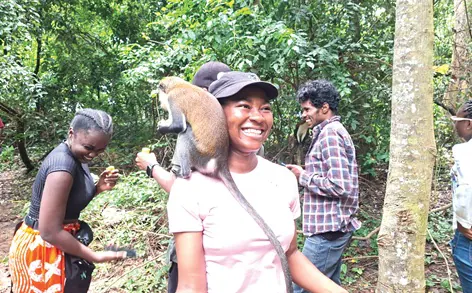
Located in the Afadjato South District of Ghana's Volta Region, the Tafi-Atome Monkey Sanctuary and Cultural Village is a 360-hectare sacred forest that has become a model for community-based conservation. The sanctuary is home to the Mona monkey, a species known for its friendly nature and striking appearance, characterized by a grey-brown coat and distinct white markings on its brows and rump. On a visit to the sanctuary on July 1, 2026, the atmosphere was filled with the sounds of chirping birds, humming insects, and whooping monkeys, creating a serene ambiance that underscores the deep connection between the local community and nature.
The relationship between the Tafi-Atome community and the Mona monkeys is deeply rooted in tradition and mutual respect. According to local guide Robert Dzandu, the monkeys are considered messengers of the gods and are protected under traditional taboos, which prohibit hunting and harming them. This spiritual significance has fostered a culture of coexistence, where residents allow the monkeys to move freely within the community without interference. In return, the monkeys have become an integral part of the community's eco-tourism initiative, with visitors offered bananas to interact with them, highlighting the intrinsic link between the monkeys' loyalty and the offering of food.
The ecological significance of the Tafi-Atome Monkey Sanctuary extends beyond its role as a tourist destination. As a critical piece of the sub-equatorial forest ecosystem, the sanctuary serves as a natural corridor that provides essential services, including forest regeneration and climate regulation. The Mona monkeys, as frugivores, play a pivotal role in dispersing seeds through their droppings, which sustains the diversity of the local flora. Additionally, the dense forest cover helps maintain local humidity and temperature levels, crucial for the surrounding agricultural lands.
Experts emphasize the importance of sacred forests like Tafi-Atome in mitigating the effects of climate change. According to Prof. Yaw Agyemang Boafo, an associate professor at the Centre for Climate Change and Sustainability Studies at the University of Ghana, sacred forests act as carbon sinks, helping to regulate local rainfall patterns and maintain cooler conditions. He stresses that beyond ecological benefits, sacred forests also support livelihoods, underscoring the need for their conservation.
The Tafi-Atome community has experienced firsthand the benefits of preserving their sacred forest. According to Mr. Dzandu, the forest has helped improve rainfall patterns, even during the dry season, and protects the community from harsh weather events. For instance, during a recent storm, the forest absorbed the impact, preventing severe damage to the community. This experience highlights the sanctuary's role in environmental stability and community resilience.
Despite its ecological and cultural significance, the Tafi-Atome Monkey Sanctuary faces persistent environmental threats. The growing local population's demand for farmland puts pressure on the forest boundaries, while climate change causes unpredictable rainfall patterns, impacting the productivity of fruit trees that sustain the monkeys. To address these challenges, the community has taken responsibility for maintaining the forest, creating fire belts during the dry season and responding collectively to fire outbreaks.
Efforts to conserve the sanctuary involve both traditional and scientific approaches. While government support is limited, non-governmental organizations contribute through research activities that monitor the monkeys' health and assess disease risks. Prof. Boafo advocates for a convergence of traditional and scientific knowledge to leverage the sanctuary's ecological, cultural, and social values, suggesting that the eco-tourism model at Tafi-Atome could be replicated across Ghana.
Key points
- The Tafi-Atome Monkey Sanctuary demonstrates a unique model of community-based conservation, where traditional practices and scientific approaches converge to protect biodiversity and promote ecological balance.
- The sanctuary's ecological significance extends beyond its role as a tourist destination, providing essential services such as forest regeneration and climate regulation.
- Despite facing environmental threats, the Tafi-Atome community remains committed to preserving their sacred forest, recognizing its importance for livelihoods and environmental stability.