Ghana is battling multiple environmental issues, including illegal mining, poorly planned settlements, and inadequate waste collection. These problems are interconnected and involve human behavior, public policy, and physical processes. The country's environmental challenges have increased its vulnerability to flooding, with plastic waste scattered along streets, beaches, and water bodies. A workshop organized by the Environmental Protection Authority, Ignite Media, and KNUSTFORD University College focused on effective communication in plastic-waste management reporting.
The workshop addressed different aspects of environmental communication and action, with experts discussing the principles of environmental communication, media reporting on plastic pollution, and climate change. Dr. Diana Afi Sebbie, Dr. Annie Owusua, Dr. Sarfo Yiadom, Dr. Godfred K. Teye, and Mr. Nathaniel Laryea shared their expertise on environmental communication, public engagement, and practical solutions. The sessions emphasized the need for effective reporting to connect policy with evidence and translate scientific ideas into understandable language.
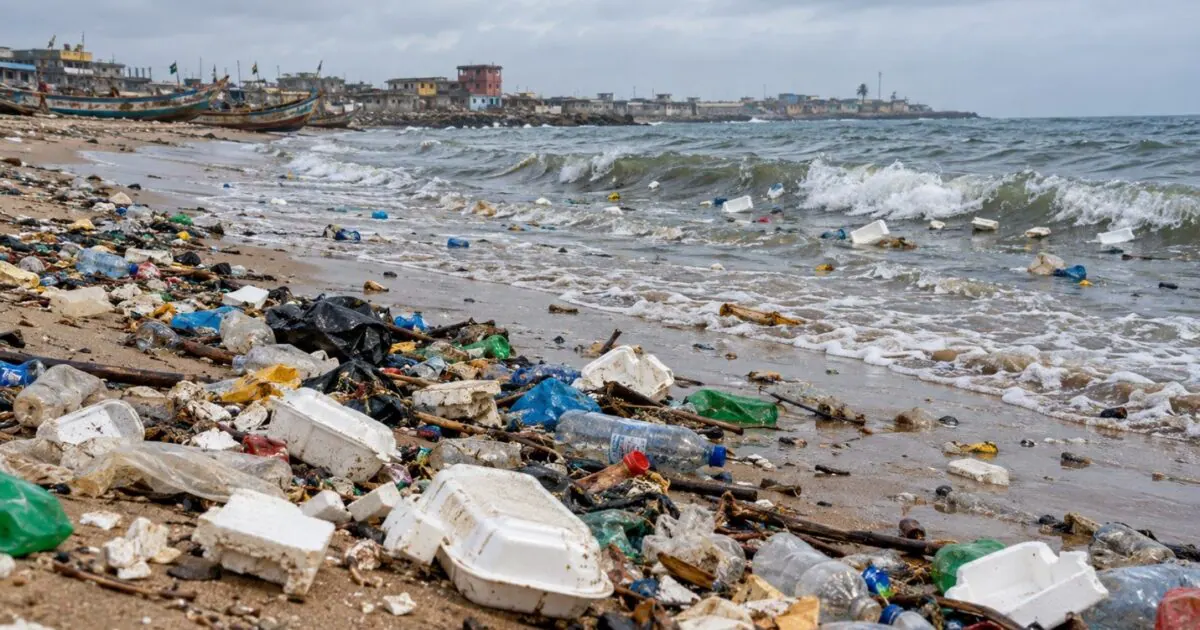
A visit to Jamestown Beach near the Gbetse Mantse Palace revealed the severity of Ghana's plastic-waste problem. The beach was heavily polluted with disposable packaging, bottles, sachets, and broken plastic materials mixed with sand and other waste. This experience transformed the issue from a theoretical problem to an immediate national concern. The scale of the problem requires national attention and coordinated institutional action, as individuals cannot solve it alone.
Physics helps understand how waste discarded in one community can accumulate along a beach like Jamestown. Plastic waste does not remain where it is thrown; gravity, rainwater, wind, rivers, and drainage systems transport it towards the sea. At the coast, waves, tides, and currents redistribute the waste, sometimes returning it to the shoreline. The shoreline becomes the final receiving point of a larger urban system.
The scene at Jamestown Beach demonstrated the law of conservation of mass, a fundamental principle in physics. Matter does not disappear after being discarded; it changes form, moves, or accumulates in the environment. For a waste system, this principle means that if plastic enters Ghana's economy but is not collected, recycled, or properly disposed of, it must end up somewhere.
Expanded polystyrene, commonly called Styrofoam, is especially mobile due to its physical structure. Its low average density allows it to float easily in water, and wind can move it easily due to its large surface area relative to its mass. A discarded takeaway pack can be carried by rainwater into a gutter, transported into a stream, and eventually discharged into the sea.
Ghana's environmental challenges require a comprehensive approach to address the interconnected issues. The styrofoam ban, set to take effect in 2027, aims to tackle plastic pollution. Understanding the physics behind waste movement and accumulation can inform effective solutions. The government, institutions, and individuals must work together to address the problem, with a focus on waste collection, recycling, and proper disposal.
Key points
- The law of conservation of mass explains that matter does not disappear after being discarded.
- Expanded polystyrene, or Styrofoam, is highly mobile due to its physical structure.
- Ghana's styrofoam ban aims to address plastic pollution and its environmental impacts.