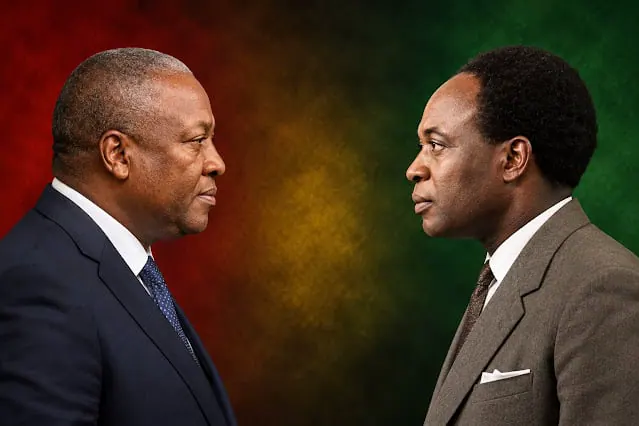
Ghana's President John Dramani Mahama has introduced an ambitious geopolitical idea: a unified economic alliance linking Africa, the Caribbean, and Latin America. This proposal seeks to expand the African Continental Free Trade Area (AfCFTA) by integrating the Community of Latin American and Caribbean States (CELAC) and the Caribbean Community (CARICOM). Mahama's vision is a strategic recalibration of global economics, leveraging AfCFTA's existing strength: a market of 1.3 billion people and a combined GDP of $3 trillion.
Mahama's proposal includes harmonizing trade standards, establishing visa-free travel agreements, and investing in cross-border logistics and digital payment systems. These steps are already unfolding, with visa-free travel agreements initiated with Suriname and Jamaica. The African Union's (AU) recognition of the Caribbean as its "seventh region" has opened the door for CARICOM nations to participate in AU discussions, laying the groundwork for deeper integration.
However, formal inclusion into AfCFTA will require new legal instruments or a parallel cooperation framework, since the current treaty applies only to AU member states. Mahama's message carries a deeper resonance, echoing across African history and evoking the unfinished dreams of leaders like Kwame Nkrumah, Patrice Lumumba, Thomas Sankara, and Muammar Qadhafi, who envisioned a strong, self-determined Africa.
Mahama's proposal reminds Ghanaians and the world that Africa has always possessed the resources, population, and intellectual capacity to shape its own destiny. What the continent lacks is not potential but coordinated power. His message is clear: Africa must no longer allow external forces to dictate its future. The continent's path must be defined by Africans themselves.
This vision is not about nostalgia but reclaiming agency and recognizing that Africa's minerals, markets, youth, and innovation are not bargaining chips for others, but pillars of a new global order. By linking Africa with the Caribbean and Latin America, Mahama seeks to revive a Pan-Africanism that is not only ideological but economically transformative.
For Ghana, Mahama's objective positions the nation once again at the center of Pan-African leadership, a role first defined by Nkrumah. It signals that Ghana is ready to champion a future where African unity is not a dream but a measurable economic force. For Africa, this proposal represents a turning point, offering a pathway to break cycles of dependency and strengthen continental solidarity.
If Africa embraces this vision, it will not only honor the legacy of Nkrumah, Lumumba, Sankara, and others; it will finally achieve what they fought for: a united, empowered continent shaping its own destiny. Mahama's idea introduces a new geopolitical reality: a Global South that is organized, confident, and economically integrated, capable of negotiating fairer trade and asserting its place in global decision-making.
Key points
- Mahama's proposal seeks to expand the African Continental Free Trade Area (AfCFTA) to create a unified Global South.
- The proposal includes practical steps such as harmonizing trade standards and investing in cross-border logistics.
- Mahama's vision echoes the unfinished dreams of African leaders like Kwame Nkrumah and Patrice Lumumba.