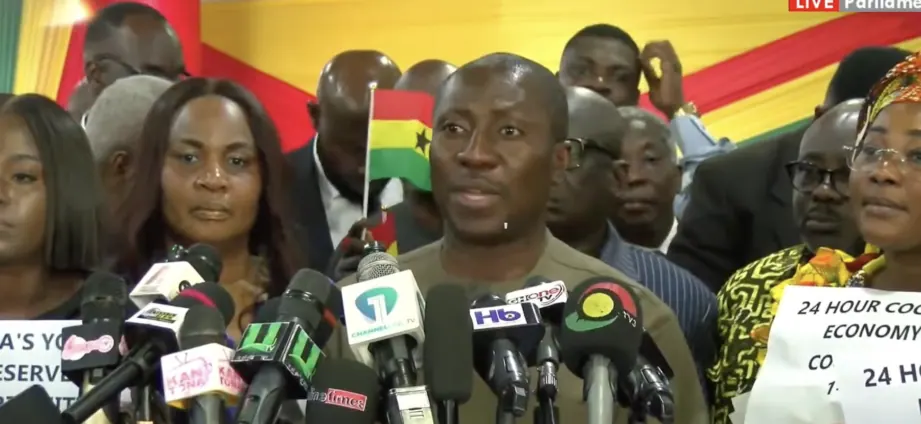
The Minority in Parliament has expressed its determination to pursue a parliamentary inquiry into major narcotics seizures linked to Ghana, despite Speaker Alban Bagbin's decision to declare the motion inadmissible. Minority Leader Alexander Afenyo-Markin stated that the Speaker erred in relying on ongoing criminal proceedings to determine whether Parliament could investigate the circumstances surrounding the seizures. The motion, filed by First Deputy Minority Whip Habib Iddrisu, sought to establish an Ad Hoc Committee to investigate how major narcotics consignments linked to Ghana were processed, inspected, cleared, and exported.
The proposed inquiry aimed to examine several narcotics seizures, including the interception of nearly 3.9 metric tonnes of cocaine by French Customs at Dunkirk on September 10, 2026, and the seizure of 320 kilogrammes of methamphetamine by Australian authorities in June 2026. The committee would have investigated the procedures used to process and clear the consignments, the ports from which they departed, and the intelligence profiling, scanning, and physical inspections conducted before export. The Minority Leader emphasized that the motion was designed to examine institutional processes rather than determine the guilt or innocence of individuals facing criminal proceedings.
Afenyo-Markin criticized the Majority for supporting the ruling, accusing it of resisting parliamentary scrutiny of the narcotics seizures. He used the phrase "24-hour cocaine" in reference to the government's 24-hour economy policy, implying that the Majority was more interested in the economy than in scrutinizing the narcotics issue. The Minority Leader stated that his caucus would explore the options available under the Constitution and Parliament's Standing Orders to keep the matter on the national agenda.
The Minority Leader described the Speaker's decision as a setback for parliamentary oversight and accountability. He alleged that the ruling reflected the government's unwillingness to face scrutiny over the issue. Afenyo-Markin warned that restrictions on parliamentary scrutiny could weaken institutional checks on executive power, adding that a supermajority must never become an excuse to weaken the minority, silence scrutiny, or diminish Parliament's duty to oversight.
The Majority supported the Speaker's ruling, after which Parliament was adjourned until further notice. Afenyo-Markin said the Minority would announce its next steps at the appropriate time, maintaining that the scale of the narcotics seizures required scrutiny of Ghana's port controls, customs procedures, intelligence gathering, and drug enforcement systems. The Minority Leader emphasized that the motion did not seek to try any accused person or determine criminal liability.
Afenyo-Markin argued that Parliament could investigate possible weaknesses in the country's security and enforcement systems without taking over the role of the courts. He stated that the Minority would not abandon its call for accountability, saying, "We will not let this matter rest. Unfortunately, the Speaker denied the Minority the opportunity to be heard." The Minority Leader emphasized that his caucus acted in the national interest and for the good of Ghana's democracy.
The issue has sparked concerns about parliamentary oversight and accountability in Ghana. The Minority's determination to pursue the probe despite the Speaker's rejection has been seen as a significant development in the country's efforts to address the narcotics issue. The outcome of the Minority's next steps remains to be seen, but it is clear that the issue will continue to be a topic of discussion in Ghana's Parliament.
Key points
- The Minority in Parliament is determined to pursue a probe into major narcotics seizures linked to Ghana despite Speaker Alban Bagbin's rejection of the motion.
- The proposed inquiry aimed to examine institutional processes and possible weaknesses in Ghana's security and enforcement systems.
- The issue has sparked concerns about parliamentary oversight and accountability in Ghana.