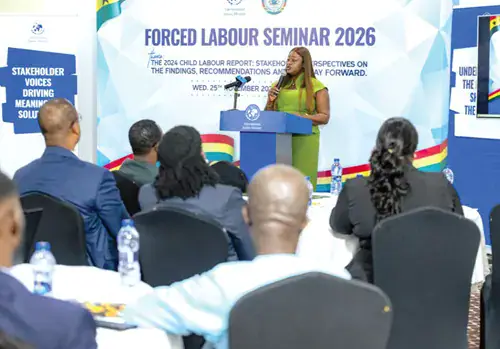
The Ministry of Labour, Jobs and Employment in Ghana has urged institutions and development partners to strengthen reporting and data-sharing to improve national coordination, policy formulation and accountability in the fight against child labour. According to the Director of the Child Labour Unit, Esther Ofori Agyemang, accurate and timely reporting is essential to identifying vulnerable communities, directing resources and assessing the effectiveness of interventions. This call was made at a stakeholders' forum in Accra to discuss the 2024 Child Labour Report.
The 2024 Child Labour Report revealed a decline in the number of children identified engaging in child labour from over 27,000 in 2023 to about 14,000 in 2024, representing a reduction of approximately 49 per cent. Consultant Emmanuel Antwi Boasiako presented the report, highlighting that the proportion of children identified in the worst forms of child labour also fell from 16.7 per cent to 11 per cent. However, only 40 per cent of male children and 35 per cent of female children identified as being in or at risk of child labour received necessary support.
Despite progress, concerns were raised about declining economic assistance to vulnerable households. Support for income-generating activities fell from about 3,700 beneficiaries in 2023 to 1,001 in 2024, while cash transfer support dropped from 1,320 beneficiaries to zero. Mr Boasiako recommended increased funding, stronger community child protection structures, improved coordination and vocational training for children aged 15 to 17 to sustain the fight against child labour.
The Director of the Child Labour Unit, Esther Ofori Agyemang, emphasised the need for a comprehensive national approach to tackle child labour, warning that focusing interventions and reporting in the cocoa sector could obscure the extent of the problem in other sectors. She called for greater attention to be given to other sectors, particularly illegal small-scale mining, domestic work and commercial sexual exploitation, where children are also vulnerable to exploitation.
Implementing agencies under the National Plan of Action were urged to integrate child labour interventions into their institutional budgets and activities. Mrs Agyemang noted that inadequate resources, limited understanding of institutional responsibilities and poor reporting remained major implementation challenges. The report is critical in helping identify regions where children are at risk and where partners should direct their attention and resources.
Stakeholders, including Anita Budu, Director of Justice Projects at International Justice Mission Ghana, called for stronger support for state institutions to address child exploitation. Ms Budu cautioned against establishing parallel structures and urged stakeholders to strengthen existing child protection institutions. She also recommended that the report be produced annually and its findings widely disseminated to ensure that the information translates into practical action to protect children.
The Ministry of Labour plans to make the annual review of child labour reports a regular exercise to enable stakeholders to assess progress, identify gaps and determine necessary interventions. Data collection and analysis for the 2025 report have been completed, with the final document expected to be shared with stakeholders. The Ministry's efforts aim to eliminate child labour and ensure that children are protected from exploitative situations.
Key points
- The Ministry of Labour urges stronger reporting and data-sharing to combat child labour in Ghana.
- The 2024 Child Labour Report shows a 49% decline in children engaged in child labour.
- Stakeholders call for increased funding and stronger support for state institutions to address child exploitation.
Reporting sources
- Ministry urges stronger reporting on child labour · Daily Graphic