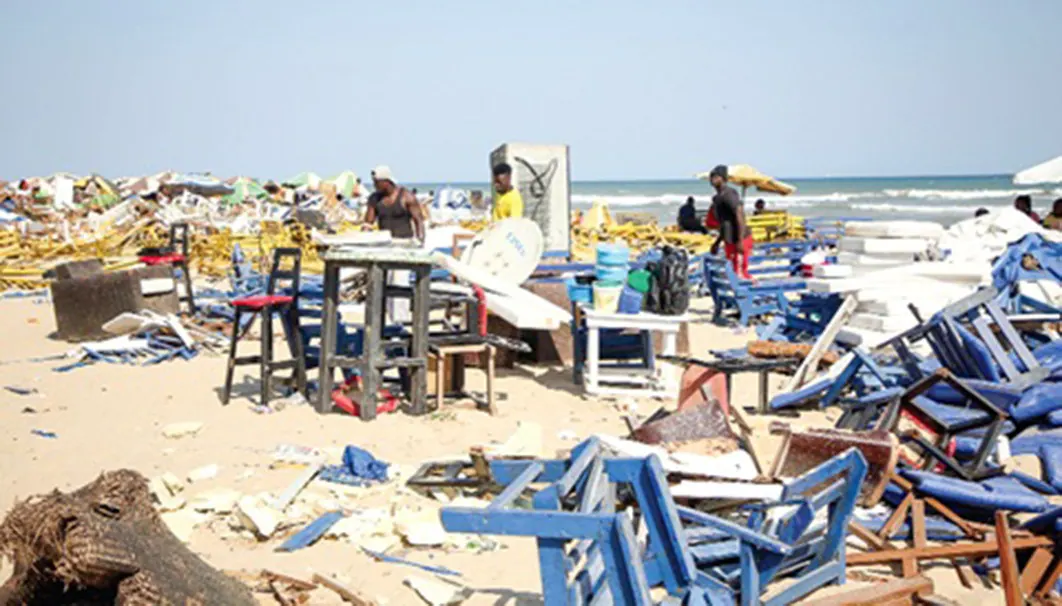
The recent demolition of unauthorized structures along La Beach, popularly known as Labadi or La Pleasure Beach, in Accra, Ghana, has generated significant public debate. On October 5, 2026, armed military and police personnel stormed the beachfront at 4:30 a.m., ordering occupants to vacate the area within 30 minutes before commencing the demolition. Several structures, including bars, shacks, and commercial installations, were reduced to rubble. The exercise was undertaken with the involvement of the National Security Secretariat.
The demolition was justified as an administrative and security clearance to remove unauthorized structures and address encroachment around the beachfront. Concerns about protecting facilities around the Labadi Beach Hotel and La Palm Royal Beach Hotel were also cited. The Ghanaian Chronicle supports the removal of unauthorized structures from public and strategically important spaces. However, the manner in which the exercise was conducted has raised questions about fairness and due process.
Some affected occupants have alleged that they were not given adequate notice before the demolition. If true, this raises legitimate concerns about the treatment of citizens and their property interests. Security considerations cannot override the need to respect citizens' legal rights. The Chronicle understands that some affected persons have commenced legal action challenging their removal. The state must allow the courts to determine the issues before them.
The state must balance its actions with the need to protect citizens' rights and property interests. Any person found to have unlawfully occupied public land must face the appropriate legal consequences, but enforcement must remain within the confines of the law. The Chronicle also notes that some affected occupants have issued threats following the demolition, which is unacceptable and must be dealt with according to the law.
The demolition has highlighted a broader national question: how did portions of Ghana's coastline become increasingly commercialized and occupied by private interests? For years, traditional authorities and private interests have facilitated the development of commercial structures along the coastline, raising questions about the management of stool lands and coastal spaces. Traditional authorities have a crucial role in land administration, but their actions must be reconciled with national planning, environmental protection, and public access.
The commercialization of public spaces has resulted in the conversion of recreational areas into commercial ventures, often requiring members of the public to pay substantial amounts to enjoy access. Accra's beaches should not become the exclusive preserve of those who can afford to pay for commercial services. They are part of Ghana's natural heritage and must be managed in a manner that balances legitimate commercial interests with public access and the wider national interest.
The state must use the La Beach operation as an opportunity to undertake a comprehensive review of developments along Ghana's coastline. The objective should not simply be to demolish structures today and allow new ones to emerge tomorrow under different arrangements. The protection of state assets, including the Labadi Beach Hotel, must go hand in hand with transparency and due process. The Chronicle commends the security agencies for taking action but urges them to ensure that future exercises respect the law and the rights of affected persons.
Key points
- The demolition of unauthorized structures at La Pleasure Beach has sparked debate over public access and due process in Ghana.
- The state must balance its actions with the need to protect citizens' rights and property interests.
- The commercialization of public spaces has resulted in the conversion of recreational areas into commercial ventures.