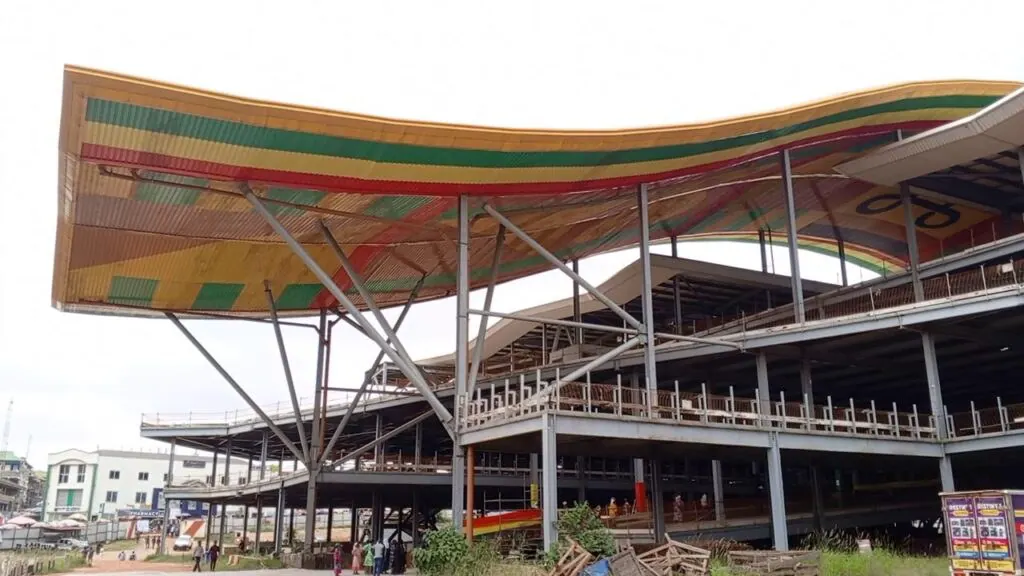
The Local Government Ministry of Ghana has expressed concerns over the resale of shops at Kejetia Market in Kumasi, where some traders who initially paid GH¢25,000 for phase-one shops have resold them for up to GH¢120,000. This practice has been deemed unfair by Local Government Minister Mahama Ayariga, who disclosed that a preliminary assessment of premium payments at the redeveloped Kumasi Central Market uncovered widespread subletting of phase-one shops far above their original price.
According to Minister Ayariga, shop owners who paid the Kumasi Metropolitan Assembly GH¢25,000 for their stalls under a five-year tenancy arrangement have been reselling or subletting them to other traders at market rates of between GH¢100,000 and GH¢120,000. This is nearly five times what they paid, and Ayariga argued that if GH¢100,000 truly reflects the market value of the shops, the assembly itself should be the one collecting premiums at that rate.
The disclosure comes amid a broader problem with premium collection at the market, where the assembly expected to collect GH¢165.3 million in premiums over the five-year lease period covering phase one. However, Kumasi Mayor Richard Agyeman-Boadi said only GH¢89 million has been collected so far, which he described as woefully inadequate to fund the completion of the project's remaining phases.
Mayor Agyeman-Boadi said the shops were sold to traders at an affordable rate, only for the assembly to discover that some people were exploiting the system. He cited the case of one individual who does not sell at the market but owns twenty shops that were reportedly sold on for GH¢100,000 each instead of the GH¢25,000 originally charged.
The revelations raise questions of fairness for traders who could not afford the inflated resale prices and may have been priced out of phase one altogether while others profited from reselling allocations meant to be affordable. The shortfall in premium collections also threatens the financing plan for the market's later phases, since revenue from phases one and two was intended to fund construction of phase three without the assembly having to borrow.
The assembly, the Local Government Ministry, and traders are expected to hold further meetings to agree on new premium values for market stalls that would generate enough revenue to sustain the facility's management. Agyeman-Boadi said the assembly plans to collect premiums at the real market value for phase two, and an independent entity is expected to be brought in to handle premium collection for phase two and subsequent phases.
Traders occupying phase one shops have also been warned to settle all outstanding premium debts by the end of December or risk losing their shops. The mayor has cautioned traders against paying anyone claiming to collect premiums for the still-unfinished phase two on the assembly's behalf, as construction of Kejetia Market's long-abandoned phase two is set to resume in October.
Key points
- Traders at Kejetia Market have resold shops for up to GH¢120,000, despite initial purchase price of GH¢25,000.
- The shortfall in premium collections threatens the financing plan for the market's later phases.
- The assembly plans to collect premiums at the real market value for phase two.