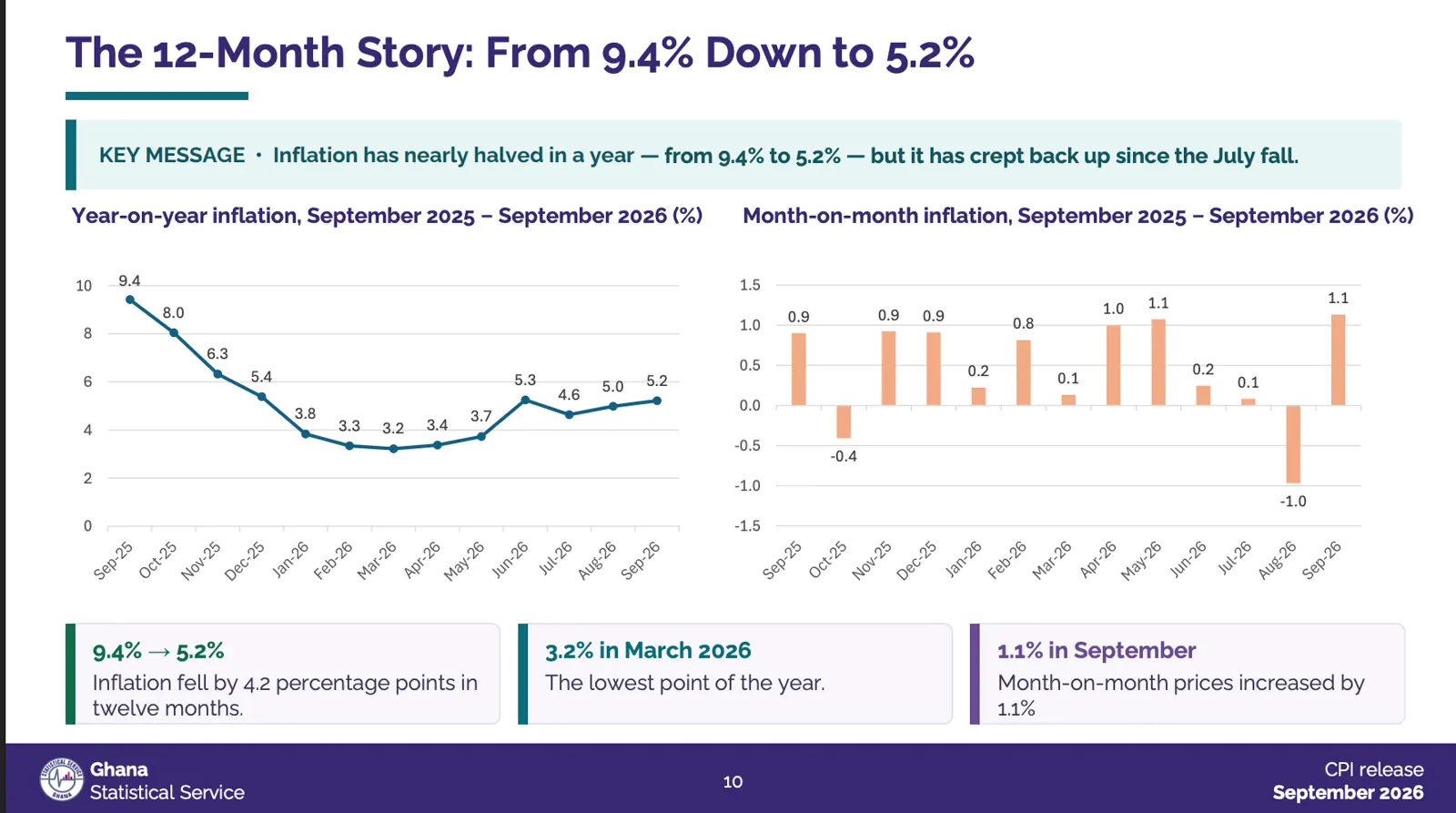
Ghana's annual inflation rate increased to 5.2 percent in September 2026, up from 5 percent in August. The rise is attributed to locally produced goods and services, which have been driving price pressures in the country. This development indicates that domestic factors continue to play a significant role in shaping Ghana's inflationary landscape. The inflation rate has been a closely watched indicator for policymakers and economists, as it affects the purchasing power of consumers and the overall economy.
The increase in inflation rate comes at a time when Ghana is seeking to attract more private capital into the biotechnology sector. The government is making regulatory processes clearer and more predictable to support projects in healthcare, agriculture, and industrial production. This move is expected to boost the sector's growth and contribute to the country's economic development. By creating a more favorable business environment, Ghana aims to become a hub for biotechnology investments in the region.
In other news, Minister for Foreign Affairs, Samuel Okudzeto Ablakwa, has inspected the VFS Global Visa Application Centre in Accra. The visit was part of a wider inspection of conditions facing Ghanaians seeking visas. The minister's visit highlights the government's efforts to improve the visa application process and ensure that Ghanaians are able to access visa services efficiently. This development is expected to enhance the country's diplomatic relations and facilitate travel for its citizens.
Meanwhile, Dr. Bernard Antwi-Boasiako's book, "The Republic," has been showcased at the United Nations Congress on Crime Prevention and Criminal Justice. The book highlights Ghana's regulatory model, which has drawn global attention. The former Director-General of the Cyber Security Authority (CSA) has contributed to the global discussion on crime prevention and criminal justice, demonstrating Ghana's expertise in this area.
In the banking sector, GCB Bank is using transaction data generated by micro, small, and medium-sized enterprises (MSMEs) to extend unsecured loans of up to GH¢1 million. This move aims to overcome poor record-keeping and documentation gaps that often restrict MSMEs' access to formal credit. By leveraging transaction data, GCB Bank is providing a new financing option for MSMEs, which are crucial to Ghana's economic growth.
The Bank of Ghana (BoG) is preparing to tighten banks' credit risk management requirements as private-sector lending accelerates. The regulator has warned that rapid credit expansion must be matched by stronger underwriting and risk controls. This move is expected to ensure that banks maintain prudent lending standards and mitigate potential risks in the financial system. The BoG's decision reflects its commitment to maintaining financial stability in the country.
Despite global uncertainty, Sub-Saharan Africa's economy remains resilient, with economic growth gaining momentum in the region. Ghana and other countries in the region are working to address domestic challenges and capitalize on opportunities for growth. The region's economic prospects are influenced by various factors, including geopolitical tensions, climate shocks, and fiscal pressures. However, its resilience and adaptability have enabled it to navigate these challenges effectively.
Key points
- Ghana's annual inflation rate rose to 5.2% in September 2026.
- The government is seeking to attract more private capital into the biotechnology sector.
- The Bank of Ghana is tightening banks' credit risk management requirements.