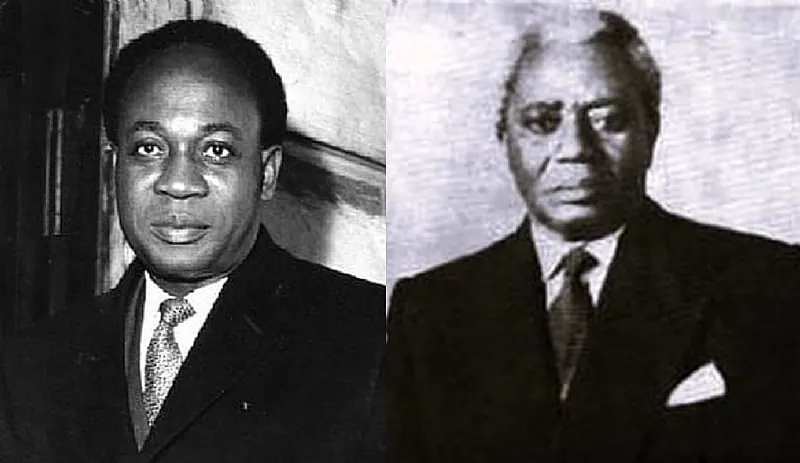
Ghanaian political analyst Kwame Okoampa-Ahoofe Jr. has responded to claims made by Atitso Akpalu, a member of the National Democratic Congress (NDC), that the New Patriotic Party (NPP) had a "phobia of progress" and sabotaged Ghana's journey to independence. In his rebuttal, Okoampa-Ahoofe Jr. argues that it is actually the NDC that has a history of obstructing Ghana's progress. He cites the country's first leaders, including President Kwame Nkrumah and Dr. J.B. Danquah, who led the country to independence.
According to Okoampa-Ahoofe Jr., Akpalu's claims are based on "patently false historical propaganda." He argues that the NPP, led by Danquah and others, was instrumental in Ghana's fight for independence. The United Gold Coast Convention (UGCC), founded by Danquah and George Alfred "Paa" Grant, was the first mass modern political organization that approximated the status of a national political party. Okoampa-Ahoofe Jr. questions Akpalu's knowledge of Ghana's history, stating that his claims betray a "screaming lack of even the most basic and readily accessible knowledge."
Okoampa-Ahoofe Jr. also questions the role of Kwame Nkrumah, who was invited to Ghana by the UGCC founders to lead the country's independence struggle. He asks whether Nkrumah's arrival was intended to sabotage the country's progress, as Akpalu suggests. Nkrumah would later become Ghana's first prime minister and president. Okoampa-Ahoofe Jr. argues that Akpalu's claims are an attempt to "hagiographize" or apotheosize Nkrumah's image, rather than presenting a factual account of history.
The debate over Ghana's independence and the role of its leaders continues to be a contentious issue. Okoampa-Ahoofe Jr. notes that even some of Nkrumah's contemporaries and later leaders have criticized his conduct on issues such as human rights and democratic governance. Former President Jerry John Rawlings and Nobel laureate Kofi Annan have made public comments on Nkrumah's shortcomings.
Okoampa-Ahoofe Jr. argues that the NDC, led by Akpalu, is guilty of sabotaging Ghana's postcolonial progress and sociopolitical integrity. He cites the example of Kojo Botsio, a former NDC leader who was accused of corruption and kleptocracy. Okoampa-Ahoofe Jr. suggests that Akpalu's claims are an attempt to deflect attention from the NDC's own shortcomings.
The exchange between Okoampa-Ahoofe Jr. and Akpalu highlights the ongoing debate over Ghana's history and politics. While Akpalu's claims have sparked controversy, Okoampa-Ahoofe Jr.'s response aims to set the record straight on the country's independence and the role of its leaders. The discussion is likely to continue, with both sides presenting their perspectives on Ghana's history and development.
The controversy surrounding Ghana's independence and the role of its leaders has implications for the country's current politics and development. As Ghana continues to evolve and grow, understanding its history and the actions of its leaders is crucial for informing its future. The debate between Okoampa-Ahoofe Jr. and Akpalu serves as a reminder of the importance of accurate historical knowledge and the need for constructive dialogue in Ghanaian politics.
Key points
- The NPP, led by Dr. J.B. Danquah, played a significant role in Ghana's fight for independence.
- Kwame Nkrumah, Ghana's first prime minister and president, has been criticized for his conduct on issues such as human rights and democratic governance.
- The debate over Ghana's independence and the role of its leaders continues to be a contentious issue in Ghanaian politics.