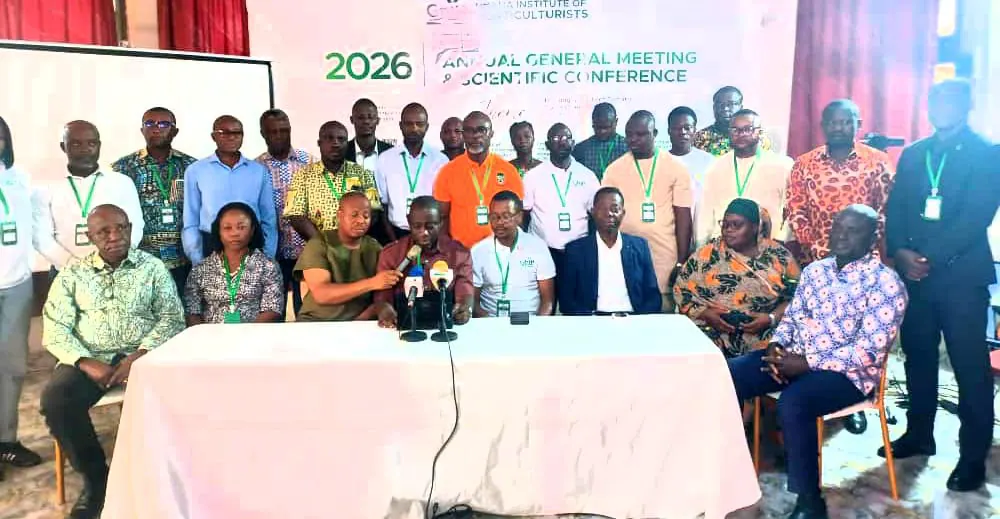
The Ghana Institute of Horticulturists (GhIH) has urged the government to establish a dedicated Horticulture Authority to oversee the development of the sector. This call was made at the close of the GhIH's 26th Annual General Meeting and Scientific Conference held at Fiapre, near Sunyani in the Bono Region. The conference brought together professionals and stakeholders from the horticulture sector to discuss ways to strengthen Ghana's tomato value chain.
The GhIH commended the government for initiatives under the Feed Ghana programme aimed at increasing domestic tomato production. However, the Institute noted that persistent challenges across the tomato value chain required targeted interventions and stronger coordination among stakeholders. A seven-point communiqué was issued, outlining the Institute's recommendations for improving the sector.
One of the key recommendations was the urgent rehabilitation of major irrigation schemes, including Tono, Vea, Bontanga, and Akumadan. The GhIH believes that improving irrigation infrastructure will help farmers sustain production beyond the main farming season and contribute to a more reliable supply of tomatoes. This, in turn, will help reduce Ghana's dependence on imported fresh and processed tomatoes.
The Institute also called for the establishment of a dedicated fund to support the development and release of locally adaptable tomato varieties. These varieties should be high-yielding, disease- and pest-resistant, and tolerant to heat. In the interim, the government is urged to subsidize recommended hybrid and open-pollinated tomato varieties approved by the Ministry of Food and Agriculture (MoFA).
The GhIH expressed its readiness to collaborate with MoFA and the Ministry of Local Government, Chieftaincy and Religious Affairs to develop tailored training programmes for Agriculture Extension Agents and Technical Officers. The training will focus on technologies and practices required to improve tomato production and post-harvest handling. This will enable farmers to adopt best practices and improve their yields.
The Institute also urged the government to increase investment in greenhouse tomato production to complement open-field cultivation, particularly during the dry season. Stronger collaboration between government and the private sector is necessary to guarantee markets and fair prices for farmers. This will help sustain farmers' interest and encourage continuous production.
The GhIH called for the urgent rehabilitation and operationalization of existing tomato-processing factories, including the Pwalugu and Wenchi Tomato Factories. Reviving these factories will expand the market for locally produced tomatoes, reduce reliance on imported processed tomato products, and create opportunities for increased youth employment. The Institute reaffirmed its readiness to work with government and other stakeholders to strengthen Ghana's horticulture industry and build a more resilient tomato value chain.
Key points
- Establishment of a dedicated Horticulture Authority to oversee the development of the sector.
- Rehabilitation of major irrigation schemes to increase dry-season tomato production.
- Revival of existing tomato-processing factories to expand the market for locally produced tomatoes.