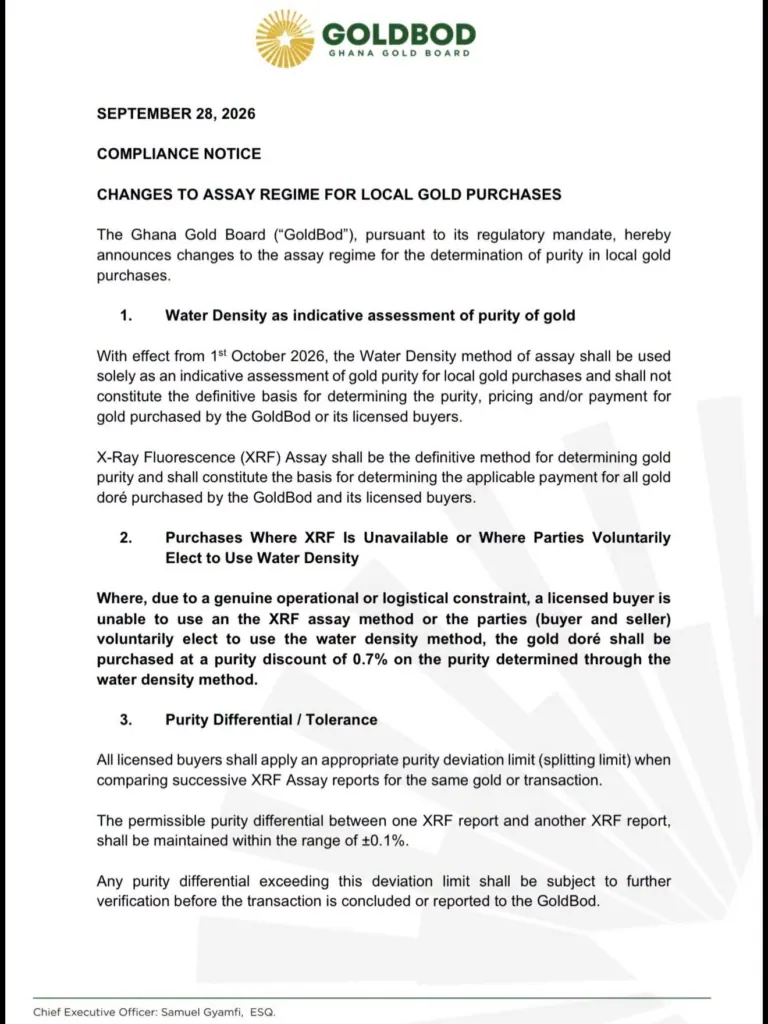
The Ghana Gold Board (GoldBod) has announced that X-Ray Fluorescence (XRF) will become the definitive method for determining the purity of gold purchased locally, effective October 1, 2026. This change aims to standardize the assay process and ensure accurate pricing and payment for gold transactions. According to GoldBod, the XRF assay will form the basis for payments for all gold purchased by the Board and its licensed buyers.
Currently, the water density method is used to assess gold purity. However, from October 1, this method will only serve as an indicative assessment and will no longer be the basis for determining pricing or payment. GoldBod has emphasized that the XRF assay is a more accurate and reliable method for determining gold purity. The Board has also introduced a new pricing structure for cases where the water density method is used due to operational or logistical constraints.
In cases where a licensed buyer is unable to use XRF or both parties agree to use the water density method, the gold will be purchased at a 0.7 percent discount on the purity determined through water density. This discount aims to account for the potential discrepancies between the two methods. GoldBod has also introduced a purity differential or tolerance requirement for licensed buyers when comparing successive XRF assay reports for the same gold or transaction.
The permissible purity difference between one XRF report and another must remain within plus or minus 0.1 percent. If the purity differential exceeds this limit, further verification will be required before the transaction is concluded or reported to GoldBod. This measure aims to prevent discrepancies and ensure the integrity of the assay process.
GoldBod has directed all aggregators and licensed buyers to ensure full compliance with the new regime from October 1. The Board has warned that failure to comply with the requirements will constitute a breach of applicable licence terms and conditions. Regulatory and enforcement measures under the Ghana Gold Board Act, 2025 (Act 1140) may be taken against non-compliant buyers.
To ensure a smooth transition, GoldBod has directed all licensed buyers and aggregators to take the necessary steps to ensure operational readiness before the implementation date. This includes acquiring the necessary equipment and training for XRF assay. The Board is confident that the new regime will enhance the efficiency and transparency of the gold purchasing process.
The introduction of the XRF assay regime is part of GoldBod's efforts to improve the gold industry's regulatory framework. The Board's decision aims to promote a more accurate and reliable assay process, ultimately benefiting both buyers and sellers in the industry. Key stakeholders are expected to adapt to the new regime, ensuring a seamless transition.
Key points
- XRF assay to become mandatory for local gold purchases in Ghana from October 1
- Water density method to be used only as an indicative assessment of gold purity
- Non-compliance with the new regime may attract regulatory and enforcement measures under the Ghana Gold Board Act.